
What are rail communication systems?
Rail communication systems are the networks that connect stations, control rooms, trackside equipment, and moving trains, carrying everything from voice and SCADA telemetry to video and passenger data. As passenger demand grows and non-passenger rail operators modernize under state-led infrastructure initiatives, these systems are under pressure to support digital transformation while keeping decades-old legacy equipment running alongside it.
What applications actually run over rail communication solutions?
Rail communication solutions typically carry a mix of mission-critical applications rather than a single service. A rail communication solution built around protected operational WAN connectivity supports automatic train supervision (ATS), centralized traffic control (CTC), SCADA, multiparty hotlines, and passenger information systems (PIS), often over multidrop and ring topologies that keep stations connected to the control room even if one segment of the network is disrupted.
| Application | What it does on the network |
|---|---|
| Automatic Train Supervision (ATS) | Tracks train positions and movements in real time so controllers can manage schedules and spacing across the line. |
| Centralized Traffic Control (CTC) | Lets a control room remotely set signals and switches across a wide stretch of track from a single location. |
| SCADA | Monitors and reports on trackside assets, power systems, and other operational technology across the line. |
| Passenger Information Systems (PIS) | Delivers real-time arrival, delay, and platform information to travelers at stations and onboard. |
Why is demand for modern rail communication systems accelerating?
Demand is accelerating because rail operators are simultaneously modernizing signaling, expanding capacity, and digitizing operations that used to run on separate, purpose-built networks. The global train communication gateways system market was valued at $210.8 million in 2025 and is projected to grow at a compound annual growth rate of 17.9% to reach $1.05 billion by 2035, driven by real-time train communication demand, smart railway system adoption, government infrastructure investment, and the integration of IoT and other advanced digital technologies onto the rail network.
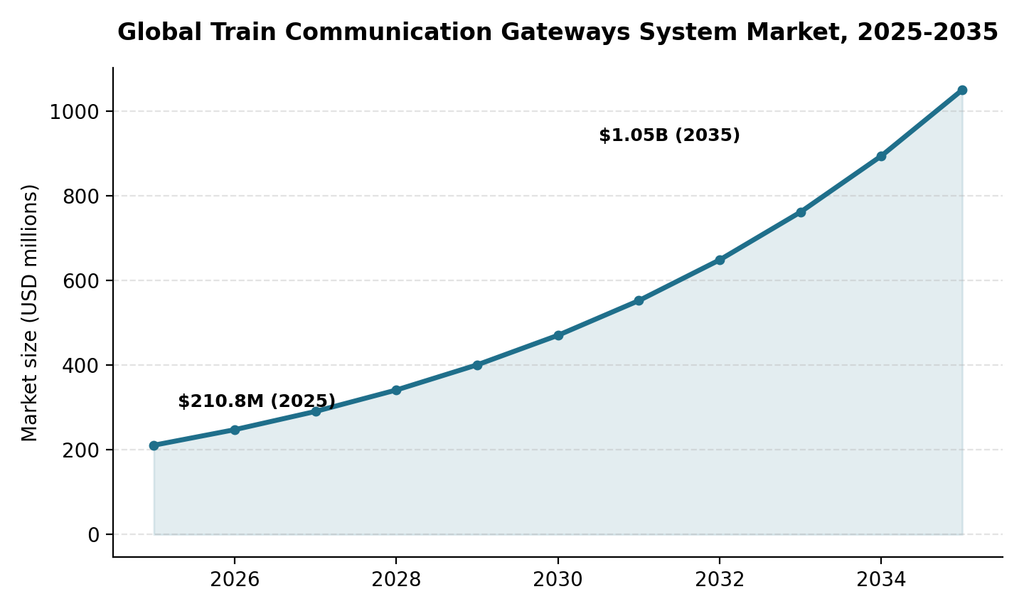
Global train communication gateways system market size, 2025 to 2035; endpoint figures are independently reported, intermediate years are a smooth CAGR-based illustration.
Where does an industrial cellular router fit into rail communication systems?
Not every trackside cabinet, level crossing, or remote signal hut sits within easy reach of fiber, and running new cable to every one of them is often impractical. This is where an industrial cellular router earns its place in rail communication systems: it gives remote or hard-to-wire sites a resilient wireless uplink, often as the primary connection in newly built-out areas and as an automatic failover path everywhere else.
An industrial 5G cellular router built for these conditions supports dual SIMs and automatic failover between cellular and wired interfaces, so a link that loses its primary connection can fail over to a second SIM or carrier without manual intervention. For sites that only need 4G connectivity, a compact industrial LTE cellular router designed for the same kind of failover offers a lower-footprint option that still integrates with RTUs, sensors, and meters commonly found in rail and transportation deployments.
What other equipment supports rail communication solutions end to end?
An industrial cellular router typically works alongside other purpose-built equipment rather than as a standalone connectivity layer. A few examples show how the pieces fit together across a rail network:
- Point-to-point wireless links: broadband wireless radios, such as sub-6 GHz point-to-point radios built for Ethernet and TDM delivery over a single link, can extend connectivity across sections of track where running new fiber is not practical.
- Encryption at the edge: a miniature SFP-based encryption device, such as a CypherPlug IP encryption SFP that encrypts traffic over any IP network, can add payload encryption to an existing link without swapping out switches or routers.
- Legacy TDM aggregation: a carrier-class multiservice TDM and packet-switched network aggregator lets operators keep circuit-switched signaling and voice equipment running while gradually shifting other traffic to packet transport.
How do rail communication solutions handle the migration from legacy to packet networks?
Most rail operators cannot simply switch off their existing circuit-switched infrastructure and start over. Rail communication solutions built for this transition are designed to support legacy TDM and Ethernet traffic delivery of analog and digital data and voice devices side by side, migrating traffic to packet, cellular, and wireless networks in stages rather than all at once. That gradual approach matters because a signaling or SCADA outage during a migration window is not an acceptable risk on a live rail network, so the equipment carrying that traffic needs to support both the old and new worlds at the same time.
What security considerations come with modernizing rail communication systems?
As rail communication systems connect more trackside sensors, cameras, and remote sites, protecting those communication channels from unauthorized access becomes as important as keeping them online. Digital transformation in rail networking typically pairs the move to packet and cellular connectivity with cyber-secure asset monitoring, so operators gain visibility into what is happening across the network without opening up new attack surfaces at every remote site they connect. Because many of these remote sites now reach the network over public cellular links rather than a private, physically secured fiber run, the router or gateway sitting at that site increasingly needs to handle authentication, access control, and encryption itself, rather than relying solely on protections further back in the network.
Frequently Asked Questions
What is the difference between rail communication systems and rail communication solutions?
The terms are largely interchangeable in practice. “Rail communication systems” typically refers to the underlying network and equipment, while “rail communication solutions” often describes the combined offering, hardware plus the applications it supports, such as ATS, CTC, SCADA, and PIS.
Why would a rail operator use an industrial cellular router instead of running fiber everywhere?
Fiber is not always practical or cost-effective to run to every remote signal hut, level crossing, or trackside cabinet. An industrial cellular router provides a resilient wireless connection to those sites, often with dual-SIM failover, without the time and expense of a full fiber build-out.
Can rail communication solutions support both legacy and modern equipment at the same time?
Yes. Many rail communication solutions are built to carry legacy TDM traffic and modern Ethernet and IP traffic side by side, which allows operators to migrate to packet, cellular, and wireless networks gradually instead of replacing everything at once.
What kinds of applications rely on rail communication systems?
Common applications include automatic train supervision (ATS), centralized traffic control (CTC), SCADA for asset monitoring, multiparty hotlines between stations and control rooms, and passenger information systems (PIS).
