
TL;DR: Faster 5G networks alone do not guarantee a stable live stream. Reliable transmission in the field comes down to how many connections are combined, how the system handles congestion, and what happens the moment coverage drops.
The move to 5G broadcasting has genuinely changed what is possible for live production away from a studio, with higher bandwidth ceilings and lower latency than the previous generation of networks. But a faster network alone does not make a stream reliable. Anyone who has watched a 5G phone connection drop to a crawl inside a packed stadium knows that raw speed and consistent delivery are two different problems.
What does 5G actually change?
Where 5G genuinely helps is in the ceiling it raises. Higher throughput supports higher bitrates for 4K and HDR content, and lower latency narrows the delay between what happens on the field and what a viewer sees. Some newer deployments also support network slicing, where a carrier allocates a prioritized portion of capacity to a specific use case, which in principle lets a broadcast connection get preferential treatment over general consumer traffic on the same tower. That capability is still emerging rather than universal, and it depends heavily on what a given carrier has enabled in a given location. None of it changes a more basic problem: a single connection, on any network generation, is still a single point of failure.
Why does bonding matter more than the network generation?
The core idea behind bonded cellular transmission is simple: combine several independent network connections into one logical uplink, so that no single network’s congestion or dead spot takes the whole stream down. A single 5G connection can be the fastest option available at a given moment and still fail entirely if that one tower gets congested. Bonding two, four, or more connections, mixing carriers and network types where possible, spreads that risk in a way no single network generation can on its own. A 4G connection bonded with 5G and WiFi is often more dependable in practice than 5G running alone.
What happens when the connection isn’t perfect?
Cellular networks do not deliver data in a clean, ordered stream even under good conditions. Packets arrive late, out of order, or not at all, and whatever sits behind the transmission has to reassemble that mess into a smooth picture in real time. This is the layer most viewers never think about, but it decides whether a brief network hiccup shows up as a barely noticeable pause or a hard freeze. It matters just as much as bandwidth does, and it is much harder to see on a spec sheet.
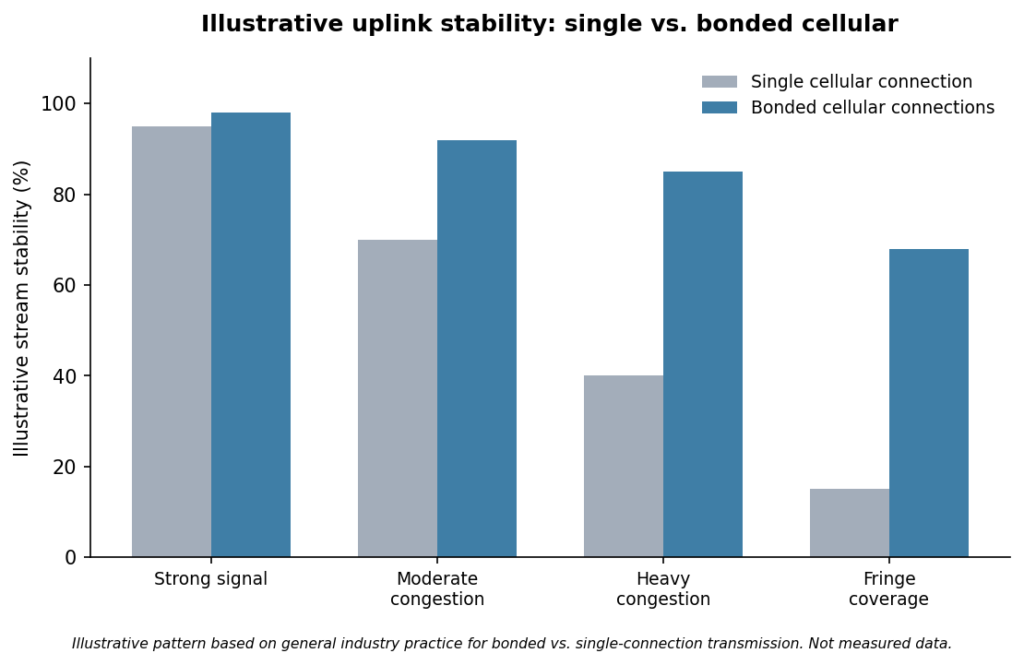
Illustrative pattern of stream stability for a single cellular connection versus bonded cellular connections across signal conditions. Not measured data.
What should a crew rely on when coverage is thin?
Coverage maps look impressive until a crew is standing in a stadium concourse, a rural venue, or a basement press room. A transmission approach that only works on strong 5G signal is not field-ready. What matters is graceful fallback, automatically drawing on 4G, WiFi, or satellite connections alongside 5G so the stream keeps running on whatever mix of networks is actually available at that location, combined with bitrate that adapts continuously rather than holding a fixed number regardless of conditions. The full technical explanation of how this fits together with IP bonding is worth reading for anyone evaluating a field transmission setup in detail.
A strong 5G signal with no bonding is still one dropped connection away from a failed stream. Multiple bonded connections with no fallback plan will still stutter the moment one network drops out. Reliability in the field comes from all of this working together, not from any single spec on a data sheet.
Frequently Asked Questions
Does 5G alone make live video transmission reliable?
No. 5G raises the ceiling on bandwidth and latency, but reliability depends on bonding multiple connections and having automatic fallback when coverage is thin.
What is cellular bonding?
Cellular bonding combines several independent network connections, such as multiple SIM cards or carriers, into a single logical uplink so that no one connection’s failure takes down the entire stream.
Why does bitrate adaptation matter for live streaming?
Available bandwidth in the field changes constantly. Continuously adjusting bitrate to match current conditions keeps a stream watchable, while a fixed bitrate will eventually outrun the network and freeze.
