29.4 C
Israel
Tuesday, June 23, 2026
HomeNewsTechnologySecurity AutoDesigner Review: Automating TARA for Faster, More Accurate Automotive Cybersecurity Compliance

Security AutoDesigner Review: Automating TARA for Faster, More Accurate Automotive Cybersecurity Compliance

Related stories

Generative Engine Optimization (GEO): The New Frontier for B2B Tech Visibility

The traditional digital lookup landscape has undergone a permanent...

AI Data Leakage Prevention: Stopping Sensitive Data Exfiltration in GenAI

The rollout of conversational generative AI tools across enterprise...

Micro Soldering and Fine-Wire Connectivity in Medical Electronics

Winding an ultra-fine electromagnetic coil represents only the first...

Exporter of Record (EOR) Architecture: Securing Tech Infrastructure Clearance

The implementation of professional exporter of record services completely...

For automotive OEMs and Tier-1 suppliers navigating the strict compliance landscapes of ISO/SAE 21434 and UNECE Regulation 155, Threat Analysis and Risk Assessment (TARA) sits at the very center of the engineering lifecycle. It is also one of its most resource-intensive components. Traditionally performed manually, TARA demands deep cybersecurity expertise, considerable time, and consistent repetition as software-defined vehicle architectures evolve.

Security AutoDesigner, an automated CI/CD security engine developed by PlaxidityX, addresses this challenge directly. By automating the TARA process using state-of-the-art AI technology and a purpose-built automotive threat database, the tool aims to clear critical engineering bottlenecks. This review examines what the product does, how its automated workflow is structured, and who it is designed to serve.

The Problem It Solves: Manual TARA at Scale

As modern vehicles shift toward software-defined architectures, a single vehicle can easily contain well over 100 electronic control units (ECUs), with each individual unit requiring its own dedicated risk assessment. Any subsequent change to the software configuration—whether driven by a new feature, a supplier firmware update, or an emerging vulnerability—triggers a mandatory requirement to update the TARA. For engineering teams working across multiple vehicle programs simultaneously, maintaining this posture manually introduces a massive operational burden.

According to product data published by PlaxidityX, transitioning from manual workflows to automated TARA engines yields several major operational advantages:

  • Efficiency: Reduces manual engineering effort by 60% to 80%.
  • Time-to-Market: Accelerates product release cycles by stripping away manual review lag.
  • Consistency: Eliminates subjective human bias in architectural risk scoring.
  • Real-Time Adaptation: Dynamically updates risk registers as the threat landscape evolves.
  • Audit Readiness: Automatically generates documentation optimized for regulatory type approval.

Core Features and Capabilities

Security AutoDesigner maps directly into modern DevSecOps pipelines, providing engineering teams with several distinct features:

FeatureDescription (per PlaxidityX product documentation)
Continuous TARA UpdatesAutomatically revises assessments based on product architecture changes, software updates, or newly identified vulnerabilities.
Vehicle and ECU-Level ScopeSupports both vehicle-level risks (e.g., CAN bus exploits) and component-level TARA for individual sensors and ECUs.
Out-of-the-Box Threat CatalogFeatures over 100 automotive threats prioritized from low to critical, compiled by PlaxidityX’s research teams.
STRIDE Threat ModelingSystematically enumerates threat vectors using the standard STRIDE methodology.
Requirements IntegrationConnects natively with common requirements management tools to keep workflows within existing developer toolchains.

How the Automated TARA Process Flows

The technical methodology underpinning the platform follows a highly structured, continuous execution flow that maps from system ingestion straight through to audit delivery:
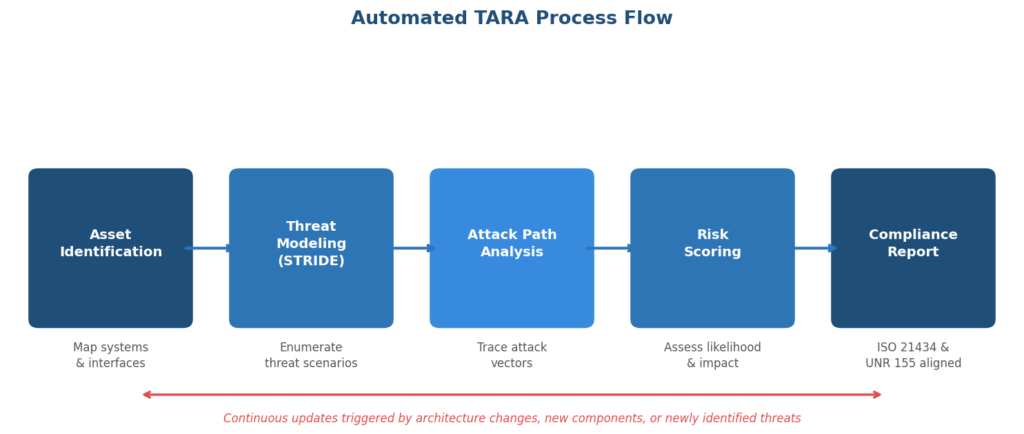
Diagram showing the five sequential stages of PlaxidityX’s automated TARA process flow: asset identification, threat modeling (STRIDE), attack path analysis, risk scoring, and compliance report generation, with a bottom arrow highlighting continuous updates.
  1. Asset Identification: Mapping the vehicle or ECU’s systems, communication interfaces, and data flows to establish what requires protection.
  2. Threat Modeling: Utilizing the STRIDE methodology to systematically enumerate threat scenarios relevant to each asset.
  3. Attack Path Analysis: Tracing potential attack vectors through the architecture to evaluate how a threat could be realized.
  4. Risk Scoring: Assessing the specific likelihood and impact of an exploit to generate a prioritized risk register.
  5. Compliance Report: Turning raw telemetry into regulatory evidence aligned with ISO 21434 and UNR 155 benchmarks.

Because vehicle codebases are constantly shifting, this process flow operates inside a continuous loop. When a new component is integrated or an external vulnerability is uncovered, the security engine triggers a targeted update across the relevant stages without forcing engineers to restart the analysis from scratch.

Compliance Coverage: ISO 21434 and UNR 155

Security AutoDesigner is built specifically to address the type approval demands of UNECE member states. The tool natively considers Annex 5 of UNECE WP.29 R155, ensuring that the out-of-the-box threat catalog maps directly to the baseline threats that vehicle manufacturers must track within their Cyber Security Management System (CSMS). For organizations preparing for external audits, the platform ensures that TARA outputs function as rigorous compliance evidence rather than mere internal engineering artifacts.

Who Benefits Most From the Platform?

The system’s technical design is highly optimized for specific industrial profiles:

  • Large OEMs: Companies managing complex, multi-variant vehicle programs where risk assessments must be scaled across dozens of component variations.
  • Tier-1 Suppliers: Suppliers facing strict, non-negotiable demands from OEM buyers to deliver fully verified, ISO 21434-aligned cybersecurity documentation with their firmware packages.
  • DevSecOps Teams: Teams working inside fast-paced CI/CD pipelines that require risk management to function as a living, automated asset rather than a static document.

Conclusion

As international compliance frameworks cross the line from voluntary standards to mandatory legal prerequisites for market entry, manual risk assessments are no longer viable at enterprise scale. By automFor automotive OEMs and Tier-1 suppliers navigating the strict compliance landscapes of ISO/SAE 21434 and UNECE Regulation 155, Threat Analysis and Risk Assessment (TARA) sits at the very center of the engineering lifecycle. It is also one of its most resource-intensive components. Traditionally performed manually, TARA demands deep cybersecurity expertise, considerable time, and consistent repetition as software-defined vehicle architectures evolve.

Security AutoDesigner, an automated CI/CD security engine developed by PlaxidityX, addresses this challenge directly. By automating the TARA process using state-of-the-art AI technology and a purpose-built automotive threat database, the tool aims to clear critical engineering bottlenecks. This review examines what the product does, how its automated workflow is structured, and who it is designed to serve.

Vertical Customization Across Software-Defined Vehicles

Modern automotive systems are moving away from legacy black-box components in favor of complex, interconnected software architectures. For complete visibility across these intricate networks, engineering teams can pair their threat assessments with advanced automotive vulnerability management tooling built specifically to handle uncompiled firmware and hidden dependencies.

By integrating these specialized scanning engines into the broader pipeline, organizations can automatically trigger real-time updates to their risk profiles whenever a new software package or system variation is integrated. This targeted approach ensures that automotive developers catch underlying supply chain weaknesses long before they reach production pipelines.

The Problem It Solves: Manual TARA at Scale

As modern vehicles shift toward software-defined architectures, a single vehicle can easily contain well over 100 electronic control units (ECUs), with each individual unit requiring its own dedicated risk assessment. Any subsequent change to the software configuration—whether driven by a new feature, a supplier firmware update, or an emerging vulnerability—triggers a mandatory requirement to update the TARA. For engineering teams working across multiple vehicle programs simultaneously, maintaining this posture manually introduces a massive operational burden.

According to product data published by PlaxidityX, transitioning from manual workflows to automated TARA engines yields several major operational advantages:

  • Efficiency: Reduces manual engineering effort by 60% to 80%.
  • Time-to-Market: Accelerates product release cycles by stripping away manual review lag.
  • Consistency: Eliminates subjective human bias in architectural risk scoring.
  • Real-Time Adaptation: Dynamically updates risk registers as the threat landscape evolves.
  • Audit Readiness: Automatically generates documentation optimized for regulatory type approval.

Core Features and Capabilities

Security AutoDesigner maps directly into modern DevSecOps pipelines, providing engineering teams with several distinct features:

FeatureDescription (per PlaxidityX product documentation)
Continuous TARA UpdatesAutomatically revises assessments based on product architecture changes, software updates, or newly identified vulnerabilities.
Vehicle and ECU-Level ScopeSupports both vehicle-level risks (e.g., CAN bus exploits) and component-level TARA for individual sensors and ECUs.
Out-of-the-Box Threat CatalogFeatures over 100 automotive threats prioritized from low to critical, compiled by PlaxidityX’s research teams.
STRIDE Threat ModelingSystematically enumerates threat vectors using the standard STRIDE methodology.
Requirements IntegrationConnects natively with common requirements management tools to keep workflows within existing developer toolchains.

How the Automated TARA Process Flows

The technical methodology underpinning the platform follows a highly structured, continuous execution flow that maps from system ingestion straight through to audit delivery:

[🚨 CMS EDITOR: INSERT PROCESS FLOW DIAGRAM HERE]

  1. Asset Identification: Mapping the vehicle or ECU’s systems, communication interfaces, and data flows to establish what requires protection.
  2. Threat Modeling: Utilizing the STRIDE methodology to systematically enumerate threat scenarios relevant to each asset.
  3. Attack Path Analysis: Tracing potential attack vectors through the architecture to evaluate how a threat could be realized.
  4. Risk Scoring: Assessing the specific likelihood and impact of an exploit to generate a prioritized risk register.
  5. Compliance Report: Turning raw telemetry into regulatory evidence aligned with ISO 21434 and UNR 155 benchmarks.

Because vehicle codebases are constantly shifting, this process flow operates inside a continuous loop. When a new component is integrated or an external vulnerability is uncovered, the security engine triggers a targeted update across the relevant stages without forcing engineers to restart the analysis from scratch.

Compliance Coverage: ISO 21434 and UNR 155

Security AutoDesigner is built specifically to address the type approval demands of UNECE member states. The tool natively considers Annex 5 of UNECE WP.29 R155, ensuring that the out-of-the-box threat catalog maps directly to the baseline threats that vehicle manufacturers must track within their Cyber Security Management System (CSMS). For organizations preparing for external audits, the platform ensures that TARA outputs function as rigorous compliance evidence rather than mere internal engineering artifacts.

Who Benefits Most From the Platform?

The system’s technical design is highly optimized for specific industrial profiles:

  • Large OEMs: Companies managing complex, multi-variant vehicle programs where risk assessments must be scaled across dozens of component variations.
  • Tier-1 Suppliers: Suppliers facing strict, non-negotiable demands from OEM buyers to deliver fully verified, ISO 21434-aligned cybersecurity documentation with their firmware packages.
  • DevSecOps Teams: Teams working inside fast-paced CI/CD pipelines that require risk management to function as a living, automated asset rather than a static document.

Conclusion

As international compliance frameworks cross the line from voluntary standards to mandatory legal prerequisites for market entry, manual risk assessments are no longer viable at enterprise scale. By automating automotive TARA tasks, Security AutoDesigner addresses a major compliance bottleneck. It provides defense teams with a structured, efficient, and highly scalable entry point to guarantee vehicle security from design to post-production.ating automotive TARA tasks, Security AutoDesigner addresses a major compliance bottleneck. It provides defense teams with a structured, efficient, and highly scalable entry point to guarantee vehicle security from design to post-production.

Subscribe

- Never miss a story with notifications

- Gain full access to our premium content

- Browse free from up to 5 devices at once

Latest stories