What actually separates a custom carrying case from an...
The implementation of professional exporter of record services completely resolves the severe compliance bottlenecks that international corporations encounter during outbound technical shipping campaigns. When international corporations upgrade global infrastructure, route hardware replacements, or return leased network data units, the legal focus shifts heavily to outbound shipping compliance. National border authorities run stringent regulatory inspections on outbound trade lanes to protect domestic economic interests and enforce international trade embargoes.
Consequently, exporting specialized technology items—such as high-end data servers, encryption equipment, or telecommunication modules—without verified documentation regularly triggers severe operational bottlenecks at the port of departure. Standard logistics loops frequently mismanage these requirements. This breakdown happens because the shipper lacks a dedicated legal entity registered to clear outbound customs in the origin territory.
Therefore, to solve these outbound friction points, data security managers and compliance directors are incorporating a specialized exporter of record framework into their logistics pipelines. This operational approach shifts all outbound border liabilities from the equipment owner to a designated third-party compliance team. This analysis reviews the regulatory requirements governing high-tech exports, evaluates why generic freight handling groups struggle with advanced hardware, and details how a dedicated EOR service structure eliminates international clearance latency.
Risk Indices and Operational Latency Profiles
A primary challenge when exporting enterprise technical assets involves the proper management of dual-use hardware regulations. Many corporate computing components, cryptographic tools, and networking nodes possess technical traits that classify them as dual-use items. This means they have both commercial and potential military uses. Outbound customs teams inspect these goods closely to verify their destination, end-use, and final recipient.
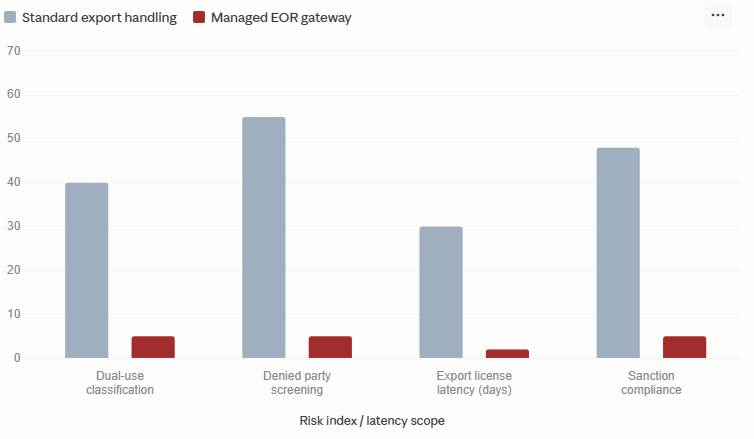
The comparison chart below highlights how a managed gateway systematically mitigates key compliance failure rates and reduces export license waiting timelines compared to standard freight handling methods:
Column bars contrast standard export handling against a managed EOR gateway, displaying a drop in dual-use classification errors, reduced denied party screenings, faster export license latency, and tighter sanction compliance.
Risk Index / Latency Scope
Standard Export Handling
Managed EOR Gateway
Dual-Use Classification
High error rates due to complex tech specs
Automated validation; minimized exposure
Denied Party Screening
Vulnerable to outdated watchlist databases
Real-time continuous compliance sweeps
Export License Latency (days)
Extended delays extending up to thirty days
Optimized filing; reduced to minimal margins
Sanction Compliance
Prone to severe regional trading oversights
Complete structural tracking across all links
Overcoming Dual-Use and Denied Party Constraints
Standard freight forwarding setups are rarely equipped to process complex military-commercial classifications. As a result, this lack of specialized knowledge can produce lengthy inspection delays or accidental trade law violations. A managed EOR services workflow addresses this challenge directly by running systematic reviews before shipping.
Specifically, the service conducts exhaustive Denied Party Screenings against international watchlists. It also manages the collection of all necessary export authorizations from governing bodies, ensuring a smooth path through border checkpoints.
Furthermore, an exporter of record is the legally recognized individual or corporation officially documented on export clearance declarations. The documented entity takes full civil and fiscal responsibility for an outbound shipment. The documented EOR is legally required to verify that the cargo adheres to all regional export control laws. Consequently, they confirm that the items do not violate localized trade sanctions and obtain all necessary regulatory permits prior to port dispatch.
Eliminating Outbound Disruptions Globally
For high-tech and enterprise hardware firms, utilizing dedicated exporter of record services completely eliminates the administrative overhead of registering local tax and trading footprints in every origin country. The trade specialist steps in as the local exporter. This intervention validates the accuracy of all documentation to insulate the original equipment owner from direct export compliance penalties.
Integrating an automated, professional EOR infrastructure resolves vulnerabilities by ensuring that all outbound paperwork is fully prepared before the cargo leaves the warehouse. For example, global data centers routinely leverage these specialized EOR compliance solutions to return leased network hardware safely without local business registrations. This thorough verification minimizes export license latency down to historical lows, helping enterprise groups execute rapid global hardware replacements and return workflows safely and predictably.
Conclusion
Outbound trade compliance requires the same rigorous oversight and strategic tracking as inbound customs entry. Relying on standard shipping networks to transport critical technology infrastructure introduces significant compliance risks and unpredictable timeline disruptions. If border inspectors uncover incorrect hardware classifications or missing export permits, standard transport agents cannot legally resolve the dispute.
In contrast, utilizing a professional Exporter of Record framework provides global technology brands with a reliable way to manage cross-border export liabilities. It passes dual-use documentation checks and optimizes international shipping timelines perfectly. As international export restrictions continue to expand, adopting specialized EOR structures remains an essential tool for maintaining absolute compliance across global supply chains.