
The rollout of conversational generative AI tools across enterprise environments has introduced a significant data loss prevention (DLP) challenge for modern information security offices. While employees look for ways to optimize daily tasks like code writing, file formatting, and report generation, they regularly input sensitive text tokens directly into web-based assistants. Traditional data loss prevention tools, built to find predictable patterns like credit card formatting, are completely blind to the contextual data movements inside natural language prompts. When an employee pastes a proprietary corporate strategy or patent-pending code block into an external model, old filters miss it entirely—exfiltrating corporate data silently and creating major security risks.
To prevent these unmanaged data leaks, companies are replacing old security tools with specialized AI data leakage prevention systems. These modern gateways use context-aware natural language processing to inspect outbound web data in real time, masking sensitive data tokens before they leave the corporate network. This review looks at how data exposure occurs in AI environments, why old filtering rules fall short, and what design features separate advanced inline AI security gateways from basic proxy systems.
The Flaws of Legacy DLP in Natural Language Channels
Traditional cloud data loss prevention systems are built around static regex patterns and file fingerprinting matrices. While highly effective at blocking the transfer of raw database files, these tools struggle when sensitive data is rewritten or embedded within a longer conversational prompt.
For example, if an engineer asks an unsecured LLM to find flaws in a proprietary piece of source code, traditional filters will often let the request pass through because it looks like standard web text. A dedicated GenAI DLP gateway solves this by analyzing the contextual meaning of outbound tokens, allowing it to identify and mask sensitive corporate assets or sensitive data in AI tools instantly.
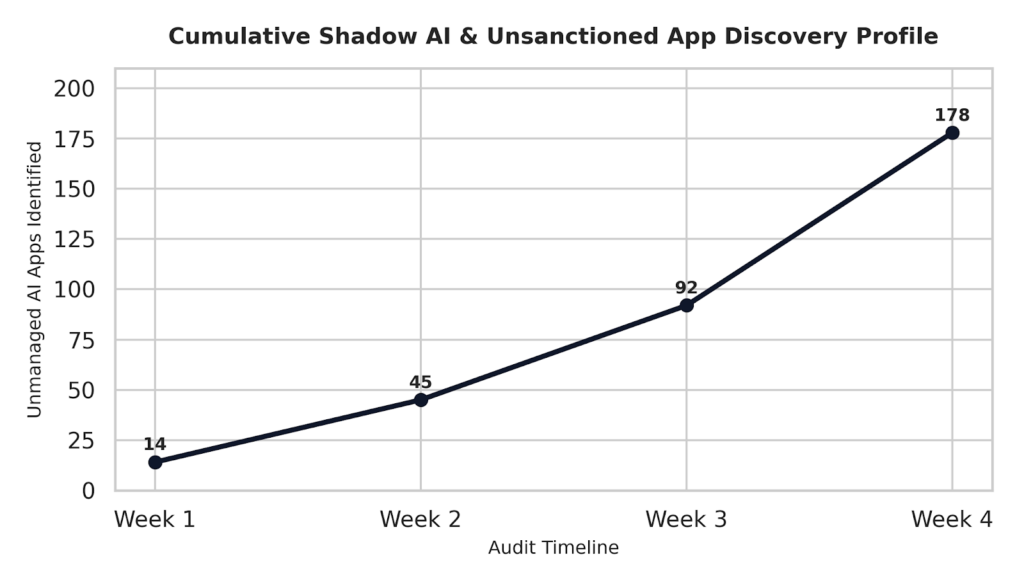
Cumulative Shadow AI & Unsanctioned App Discovery Profile
The chart below maps the typical volume of unmanaged generative AI tools and unsanctioned model endpoints discovered over a standard 4-week corporate network sweep:
Core Capabilities of an AI Data Loss Prevention Platform
A complete security architecture built to protect conversational AI channels must include several critical capabilities:
- Context-Aware Token Masking: Automatically finding and masking sensitive variables like PII, API credentials, and internal source code within active prompts.
- Inline Semantic Interception: Inspecting and modifying outbound text flows in real time, keeping system latency low to maintain a smooth user experience.
- Custom Policy Enforcement: Giving administrators the ability to set unique data sharing rules based on user roles and specific AI tool categories.
- Detailed Regulatory Compliance Mapping: Tracking and logging all AI interactions automatically to simplify compliance with major data rules like GDPR and HIPAA.
Hardening the Corporate GenAI Perimeter
Securing an enterprise AI environment requires a data protection framework that can adapt to changing user behavior. Because employees use a wide variety of public and internal AI tools daily, relying on simple, point-in-time security audits creates wide windows of exposure.
Deploying a dedicated AI data loss prevention enterprise gateway allows organizations to prevent data leakage through AI tools automatically, helping them maintain strict data compliance while safely adopting advanced AI technology.
Conclusion
AI data leakage prevention has become a mandatory component of modern corporate data protection and compliance strategies. The ease of entering text into public generative tools requires companies to adopt active, automated filtering systems built specifically for natural language analysis. As organizations continue to rely on generative AI to drive business value, using intelligent inline security gateways remains essential for protecting corporate secrets and maintaining data compliance across all conversational channels.
