
| Key Takeaways • Medical device investors weigh the FDA pathway and clinical evidence a device needs before they weigh market size. • FDA review goals are 90 days for a 510(k), 150 days for a De Novo request and 180 days for a PMA, measured in FDA days that exclude sponsor hold time. • In 2025 the median calendar time from receipt to decision was 142 days for a traditional 510(k), 271.5 days for a PMA and 299 days for a De Novo request. • Clinical work can span multiple years before a submission, so financing plans are built around reaching the next regulatory milestone. |
How do medical device venture capital firms assess a deal?
Medical device venture capital firms underwrite the regulatory pathway and the clinical evidence a device needs before they weigh market size. The reason is that a device cannot reach patients in the United States until it is cleared, granted or approved, and the route chosen determines how long that takes and how much evidence must be generated.
Regulatory milestones therefore work as the scorecard for a young device company. Elron Ventures’ public disclosures show how this looks in practice: its regulatory milestone disclosures record that BrainsGate submitted its PMA application to the FDA on February 2, 2020 and received CE approval on May 6, 2020, each reported as a separate event on the investor relations timeline.
Readers who want to see how a long-running investor frames this category can start with a medical device investment portfolio, which lists the company’s holdings in the field. Pairing a portfolio view with a regulatory timeline makes it easier to see which companies are waiting on a decision and which are already selling.
Which FDA pathway applies to which kind of device?
The pathway depends on risk and novelty: Class III devices generally need premarket approval (PMA), Class II devices use a 510(k) premarket notification when their intended use and technology resemble something already classified, and novel low-to-moderate risk devices without a predicate can use the De Novo route. These distinctions come from an FDA overview of device premarket pathways.
Each route has its own review goal. The same FDA material lists goals of 90 days for a 510(k), 150 days for a De Novo request and 180 days for a PMA, plus a 75 day goal for a Humanitarian Device Exemption. Before submission, sponsors can use a pre-submission to start early regulatory discussions with the agency and develop a path forward.
The boundaries between routes are defined by predicates and risk. A De Novo request applies when a device has no predicate, does not fit an existing Class III classification regulation and has no approved PMA for the same device type. Class I devices are low risk and are typically handled under general controls. If the FDA finds that a device is not substantially equivalent to a predicate, the device is Class III by default, and the applicant can submit a new 510(k), request De Novo classification, petition for reclassification or file a PMA.
How long do FDA reviews really take?
Calendar time runs well beyond the stated goals. In 2025, the median traditional 510(k) took 142 calendar days from receipt to decision, the median PMA took 271.5 days and the median De Novo request took 299 days, according to an analysis of openFDA exports by Pure Global.
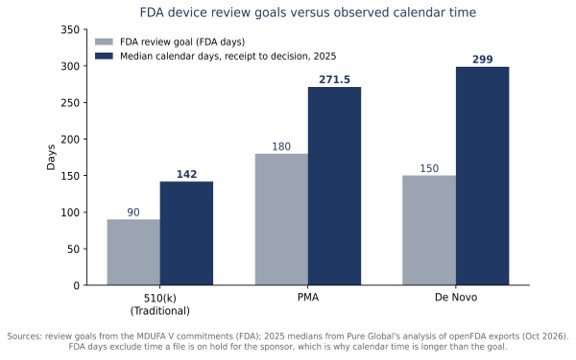
The gap exists because the goals count only FDA days and exclude time a submission is on hold waiting for the sponsor. The same analysis shows the scale of each channel: the agency cleared 3,198 devices through 510(k), granted 27 De Novo requests and approved 38 original PMAs in 2025, so clearances outnumber the other two combined by roughly fifty to one.
Within the 510(k) channel, the type of submission also matters. The analysis reports 2,655 Traditional clearances in 2025 with a median of 142 calendar days and a middle half of decisions between 90 and 231 days, versus 481 Special 510(k) clearances with a median of just 30 days. Annual 510(k) clearances have stayed within a narrow band, from 2,930 in 2016 to 3,299 in 2023, so the channel is stable even as individual timelines vary.
These medians describe every device type that used each channel, not only venture-backed ones, so an individual company’s timeline can sit well above or below them. A founder preparing a model should treat the median as a planning anchor and build in room for additional information requests, which pause the review clock and extend calendar time.
Goals are also probabilistic. For De Novo requests, the FDA committed under its fifth user fee agreement to a decision within 150 FDA days for at least 70% of submissions, so some requests will take longer than the headline number even before sponsor hold time is counted.
For an investor, that distribution makes pathway selection a core part of diligence. A 510(k) company can plan around a decision within roughly five months of submission, while a company on the PMA or De Novo route has a longer and less predictable calendar.
Why does clinical evidence change the financing plan?
Clinical evidence determines how much capital a company needs before an authorization decision. The FDA overview notes that the nonclinical and clinical study phase may occur over multiple years of development, which means a company on a PMA route may need to fund years of work before the review clock even starts.
Product milestones show how that plays out. Nitinotes received FDA investigational device exemption approval to begin a pivotal U.S. trial of its EndoZip system for endoscopic sleeve gastroplasty, according to a 2025 investor presentation, and later received a CE Mark that enabled a European commercial launch. The two milestones opened different markets, one by authorizing a trial and the other by authorizing sales.
That sequence is useful for founders reading investor questions. When an investor asks about the next regulatory milestone, the underlying question is how much capital the company needs to reach it and what that milestone unlocks for the next financing.
What changes when a device company reaches an exit?
Exit timing can follow closely behind a regulatory decision, because the decision changes what a buyer still has to underwrite. CartiHeal offers a documented example: the company reported FDA approval on March 30, 2022, and the closing of its sale agreement followed on July 12, 2022, according to the investor relations disclosures listed on the same site.
That timeline is only one case, but it shows why investors track regulatory dates closely. The ordering matters for planning. Regulatory approval and commercial scale-up often happen on different clocks, and an acquirer with an existing sales channel can move faster on the second than a standalone startup can. Founders weighing a sale should therefore ask which milestone a buyer would pay for, and whether reaching it independently is feasible within the capital available.
Finally, post-approval obligations continue. Pure Global notes that FDA schedules post-market inspections for PMA devices roughly eight to twelve months after approval, so a buyer will also review manufacturing and quality systems in diligence.
Frequently Asked Questions
What does a medical device venture capital firm look for?
A medical device venture capital firm looks for a clear regulatory pathway, a realistic plan for clinical evidence and a financing plan that reaches the next milestone, in addition to the market opportunity.
How long does FDA review take for a medical device?
The FDA’s review goals are 90 days for a 510(k), 150 days for a De Novo request and 180 days for a PMA. In 2025 the median calendar time was 142 days for a traditional 510(k), 271.5 days for a PMA and 299 days for a De Novo request.
What is the difference between 510(k), De Novo and PMA?
A 510(k) clears a device similar to one already classified, a De Novo request classifies a novel low-to-moderate risk device without a predicate, and a PMA is generally required for Class III devices.
Why do clinical trials affect medical device funding?
Clinical trials can span multiple years of development before a submission, so a company must raise enough capital to complete the study and reach the regulatory decision.
