
| Key Takeaways • Free glutamate gives tomatoes their umami taste, and tomatoes have the highest L-glutamate content among vegetables of the traditional Mediterranean diet. • Glutamic acid is the predominant free amino acid in tomato fruit and generally rises with ripeness. • A University of Maine study of ten cultivars found glutamic acid varied by cultivar rather than between two ripeness stages. • Drying and processing concentrate tomato glutamate, which helps explain why paste and sun-dried tomatoes taste so savory. |
What makes a tomato taste umami?
A tomato tastes umami because of free glutamate, an amino acid that triggers the savory taste receptors on the tongue. Among vegetables of the traditional Mediterranean diet, the tomato has the highest content of L-glutamate, and the compound becomes the most abundant free amino acid in ripe fruit of cultivated varieties, according to a 2021 Journal of Food Biochemistry study of Italian tomato varieties. Aspartic acid contributes too, though it carries only about 7% of glutamate’s taste activity, and 5′ ribonucleotides such as GMP and AMP act alongside glutamate to amplify the effect.
Breeders are starting to treat this as a selectable trait rather than a happy accident. BreedX, an Israeli breeder, says it checks flavour at every cycle of its tomato programme instead of only at the end, even though that means more lines and more selection rounds. Its flavor-first tomato portfolio spans Roma-type fruit, midi-plum types and bi-colored specialties, as well as mini-plum tomato types, so the same flavor question applies across several fruit sizes.
Does ripening increase umami in tomatoes?
Yes, in most studies glutamate rises as a tomato ripens. A 1980 Japanese study on tomatoes ripened on and off the plant found glutamic acid to be the predominant free amino acid in tomato fruit, and it increased progressively with advancing ripeness in every fruit tested. A review published in the Journal of Nutrition in 2000 reaches a similar conclusion, linking flavour maturation in ripening tomatoes to rising levels of free amino acids such as glutamate, together with sugars and organic acids. The Japanese study added a useful detail: fruit picked at the mature green or turning stage and ripened at room temperature accumulated glutamate faster than fruit left to ripen on the plant.
How much do tomato varieties differ in glutamate?
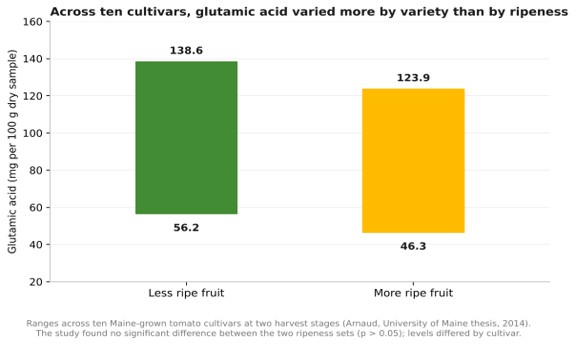
Varieties differ a great deal, and in at least one study variety mattered more than ripeness. A University of Maine thesis on glutamic acid in tomato cultivars measured glutamic acid in ten Maine-grown cultivars at two ripeness stages and found values from 56.24 to 138.56 mg per 100 g of dry sample in the less ripe set and from 46.27 to 123.88 mg in the more ripe set. The author reported no significant difference between the two ripeness sets (p above 0.05), concluding that glutamic acid levels varied by cultivar rather than by stage of ripeness. The thesis and the ripening studies are not directly comparable, since the thesis compared two ripeness sets across ten cultivars and reports values per dry weight.
The Italian study makes the same point with named varieties. Of six Campania cultivars tested, Corbarino Nocera was richest in glutamate and the hybrid Superpomodoro was richest in ribonucleotides, so a variety can lead on one umami compound and trail on the other.
Which part of a tomato carries the umami?
Umami compounds are not spread evenly through the fruit. The Italian study measured glutamate and ribonucleotides separately in the skin, outer flesh and inner pulp, and the concentration differed with the part analysed. That is one reason a whole-fruit average, like the figures above, can hide meaningful variation. It also means that how a tomato is cut, and which parts are eaten, may change the umami a person perceives.
How do drying and cooking change tomato umami?
Drying and cooking raise the concentration of tomato umami, because removing water concentrates glutamate. The Umami Information Center food guide describes tomatoes as abundant in glutamate and notes that drying decreases moisture and concentrates it. The Italian study likewise reports that free glutamic acid in tomatoes increases with ripening and with industrial processing, and the amount is higher than in other vegetables or fruits. This is consistent with the strong savory character of concentrated forms such as sun-dried tomatoes and paste.
How do researchers measure tomato umami?
Researchers measure tomato umami by extracting the fruit and quantifying glutamate with liquid chromatography, rather than relying on taste panels alone. The Italian team used HPLC and LC-MS/MS to quantify glutamic acid and 5′ ribonucleotides in the skin, outer flesh and inner pulp of six Campania varieties, including San Marzano Originale. The Maine thesis used a different route: amino acids were extracted with 80% ethanol, vacuum dried and derivatized with an internal standard before HPLC analysis with fluorescence detection. Both approaches give numbers that can be compared across varieties, but they use different units and sample preparation, which is why figures from one study should not be placed directly beside figures from another.
Is tomato glutamate the same as MSG?
Tomato glutamate is the same taste-active compound that monosodium glutamate supplies, but it occurs naturally as part of the fruit. The Italian study notes that monosodium glutamate was the first identified umami compound and that it works synergistically with 5′ ribonucleotides such as inosine monophosphate and guanosine monophosphate. The Journal of Nutrition review adds that free glutamic acid occurs naturally in most foods, including meat, poultry, seafood and vegetables. A tomato therefore combines natural glutamate with its own sugars and acids to produce a savory sweet-sour balance, not an isolated seasoning effect.
What does tomato umami mean for breeding and buying?
Because variety drives glutamate levels, umami can be improved by selection, and buyers can ask which varieties are chosen for it. The Italian authors designed their methods so they could be used to determine the sensory profile of commercial varieties, which gives breeders and buyers a way to measure umami instead of guessing. Ohio State University Extension makes the parallel point for sweetness: varieties have a natural inclination toward lower or higher soluble solids, so variety selection is one of the most direct ways to shape quality. For buyers, that means comparing suppliers on measured values, such as glutamate, ribonucleotides and °Brix, rather than on adjectives like flavourful or rich. The Italian study also assessed antioxidant properties and confirmed the nutraceutical profile of San Marzano, the best-known variety for industrial processing, so flavour and nutrition can be measured in the same set of varieties. Its authors note that tomatoes and tomato-based products are among the most consumed healthy food items, which means even small differences in flavour compounds reach a very large number of eaters.
Frequently Asked Questions
Which compound gives tomatoes their umami taste?
Free glutamate, specifically L-glutamate, is the main umami compound in tomatoes, and its concentration rises dramatically during ripening.
Does a riper tomato have more umami?
Generally yes, because glutamate is the predominant free amino acid in tomato fruit and increases with advancing ripeness, although one University of Maine study found cultivar mattered more than ripeness between two marketable stages.
Does drying tomatoes increase umami?
Drying concentrates umami because it removes water and leaves glutamate more concentrated, and published research also reports higher free glutamic acid in processed tomatoes than in fresh ones.
Which tomato variety has the most umami?
It depends on the compound measured. Among six Campania tomato varieties in a 2021 study, Corbarino Nocera was richest in glutamate while the hybrid Superpomodoro was richest in ribonucleotides.
