
| Key Takeaways• The global deep brain stimulation device market is projected to grow from about $1.3 billion in 2023 to roughly $3.5 billion by 2033, a compound annual growth rate near 10.2 percent.• Between 1996 and 2017, U.S. hospitals recorded more than 72,000 discharges involving deep brain stimulation procedures, with Parkinson’s disease accounting for about two-thirds of cases.• ISO 14708-3:2017 sets out type tests that evaluate how active implantable neurostimulators behave and respond to defined conditions before they reach production.• Coils intended for implants such as pacemakers and neurostimulators are now wound from wire as thin as eight to nine microns, often connected without traditional soldering to reduce strain and corrosion risk. |
What is a wireless implant charging coil and how does it work?
A wireless implant charging coil is a small wound-wire coil built into an implanted medical device that receives energy transmitted from an external coil through an electromagnetic field, letting the implant recharge without a wired connection through the skin. The same basic coil-and-field principle is used both ways: the same category of component can act as a receiving coil for power transfer or as a sensing coil for navigation and data transfer, depending on how it is wound and connected. coil designs built for pacemakers and deep brain stimulation components shows how this applies in practice, since active implants such as pacemakers and neurostimulators rely on very similar micro-coil construction regardless of whether the coil is moving energy, signals, or both.
Why are coils used in deep brain stimulation and other neurostimulation implants?
Coils are used in neurostimulation implants because a precisely wound conductor is one of the few components that can deliver electrical stimulation, sense signals, or transfer power within the tight space constraints of an implantable lead or electrode array. Regulatory type testing for this category is defined by ISO 14708-3:2017, which specifies tests that evaluate how active implantable neurostimulators behave and respond to defined conditions during development, ahead of routine production. how sub-millimeter coils are wound and connected for implantable devices describes the winding side of that equation, including the tolerances involved in building a coil small enough to sit inside a neurostimulation lead.
How fast is demand for implantable neurostimulation devices growing?
third-party market research projects the global deep brain stimulation device market to grow from about $1.3 billion in 2023 to roughly $3.5 billion by 2033, a compound annual growth rate of around 10.2 percent. A separate national inpatient sample found that U.S. hospitals recorded more than 72,000 discharges involving deep brain stimulation procedures between 1996 and 2017, with Parkinson’s disease accounting for about two-thirds of those cases. Growth on that scale puts sustained pressure on manufacturers to source reliable, ultra-fine-wire coil components rather than treating implantable coil supply as an afterthought in the broader device design.
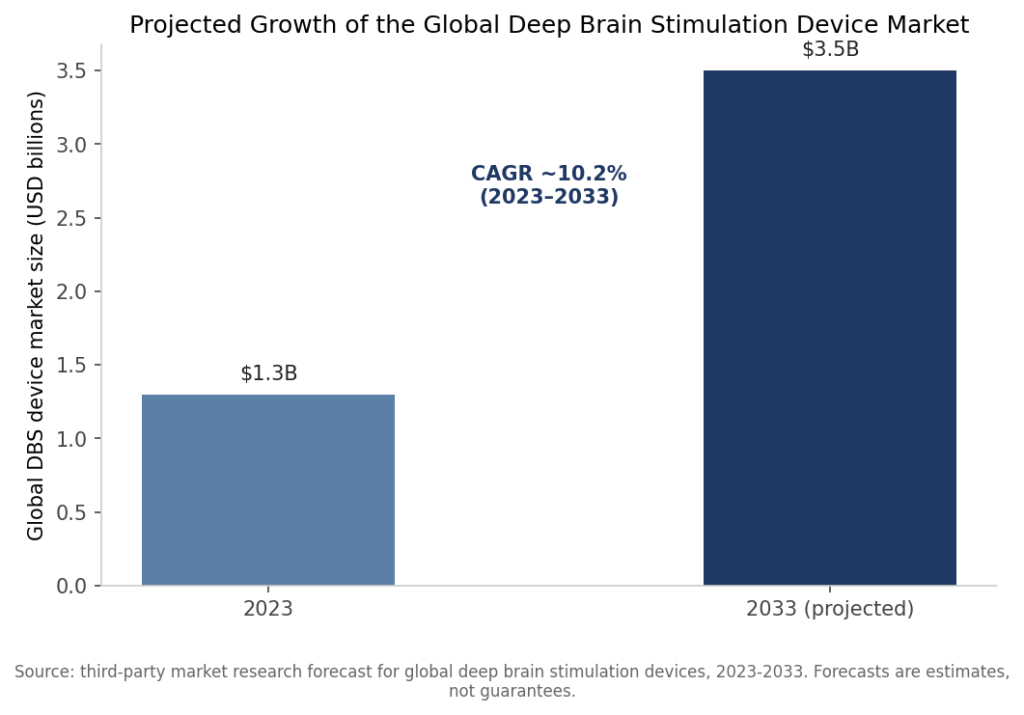
Projected global market size for deep brain stimulation devices, 2023 versus a 2033 forecast, based on third-party market research.
Do peripheral and vagus nerve stimulators use the same kind of coil as deep brain stimulators?
Peripheral nerve stimulators and vagus nerve stimulators generally rely on the same underlying coil-winding and micro-bonding techniques as deep brain stimulators, even though the target anatomy and lead routing are completely different. A vagus nerve stimulator lead, for example, has to be flexible enough to sit against a nerve in the neck without exerting damaging pressure over years of normal head and neck movement, while a deep brain stimulation lead has to survive being threaded through brain tissue to a precise depth and then remain mechanically stable indefinitely. In both cases, the wire-gauge and bonding decisions made at the component level, not just the electrode geometry, are a major factor in how long the implant lasts and how consistent its output remains over time, which is why AIMD coil supplier and PNS coil manufacturer are effectively describing the same underlying manufacturing capability applied to different anatomy.
What design considerations differ across implantable coil types?
Design priorities shift depending on what the coil is actually doing inside the body, even though the underlying winding and connection techniques are closely related across categories. The table below outlines how the primary function and the main engineering constraint tend to differ across common implantable coil applications.
| Implant Type | Primary Coil Function | Key Engineering Consideration |
| Cardiac pacemaker | Sensing / pacing lead coil | Long-term flex-fatigue resistance and biocompatible insulation |
| Deep brain stimulator | Neurostimulation lead coil | Ultra-fine wire routed through a slender, flexible lead body |
| Wireless-charged implant | Inductive power-receiving coil | Efficient energy transfer through tissue within a safe frequency range |
| Peripheral / vagus nerve stimulator | Stimulation electrode coil | Sub-millimeter diameter for placement near delicate nerve tissue |
How does implant miniaturization affect coil sourcing decisions?
As implantable neurostimulators and wirelessly powered devices get smaller, the coil supplier’s wire-handling and bonding capability becomes a hard constraint on the whole device design rather than a detail to work out late in development. A device team that commits to a lead diameter or housing size before confirming what wire gauge and winding tolerance a coil supplier can actually produce reliably risks discovering the mismatch only after tooling and regulatory submissions are already underway. For that reason, many device developers now involve a coil manufacturing partner during early feasibility work, rather than treating the coil as a commodity part to be sourced once the rest of the implant’s mechanical design is finished.
Why is soldering often avoided when connecting wires inside these coils?
Soldering is often avoided because the heat involved can oxidize ultra-fine wire, degrade its insulation, or introduce strain at the joint, any of which can shorten the reliable lifetime of a component meant to last for years inside the body. the winding process behind wireless-charging and neurostimulation coils describes how coils built from wire as thin as eight to nine microns are typically connected using pressure-based bonding rather than heat-based soldering for exactly this reason. the core functions engineers ask these implant-ready coils to perform breaks those functions down into categories such as data transfer, energy transmission, and navigation, which is useful context when specifying a coil for a new implant design.
What does biocompatibility mean for the materials used in these coils?
Biocompatibility means the wire, insulation, and any coating used in the coil have to coexist with living tissue for the intended implant duration without triggering an adverse immune response, corroding, or leaching materials into the body. For a permanent implant such as a pacemaker or neurostimulator, that requirement extends to the connection method as well as the wire itself, since a joint that corrodes or degrades faster than the surrounding wire can become the weakest point in an otherwise well-designed coil. This is one more reason connection technique is not a minor manufacturing detail for implantable coils: the bonding method chosen has to hold up to the same multi-year biocompatibility expectations as the rest of the implant, not just perform well on day one.
Frequently Asked Questions
What is a wireless implant charging coil?
It is a small wound-wire coil inside an implanted medical device that receives energy transmitted from an external source through an electromagnetic field, allowing the implant to recharge without a wired connection through the skin.
Why do implantable neurostimulator coils need special testing standards?
Standards such as ISO 14708-3:2017 define type tests that evaluate how an active implantable neurostimulator behaves and responds to defined conditions during development, before it reaches routine production.
How fast is the deep brain stimulation device market growing?
Third-party market research projects the global deep brain stimulation device market to grow from about $1.3 billion in 2023 to roughly $3.5 billion by 2033, a compound annual growth rate of around 10.2 percent.
Why is soldering often avoided when connecting wires inside implantable coils?
Traditional soldering and welding expose fine wires to heat that can oxidize the metal, degrade insulation, or introduce strain, which is a particular concern for implants that must remain reliable inside the body for years.
