
Winding an ultra-fine electromagnetic coil represents only the first stage of producing a miniature medical assembly. To transmit low-voltage signals or energy to an external monitor, the micro-wire ends must connect securely to a primary printed circuit board (PCB) or terminal pad. In advanced medical instrumentation — such as complex multi-axis orientation arrays and specialized invasive instruments — these sub-micron strands are incredibly delicate. Traditional hand soldering irons and generic hot-bar reflow tools introduce significant operational risks at this stage. The thermal blast from manual equipment can instantly melt the thin copper cores, while mechanical contact can snap the fragile connections, resulting in failed components and lower assembly yields.
To overcome these fine-wire connection hurdles, modern bio-engineering assembly lines utilize advanced non-contact termination techniques, including automated micro soldering systems and precision micro welding arrays. This analysis evaluates the thermal management risks that impact manual wire connections, details how automated laser systems eliminate structural defects, and explains why thermo-compression techniques preserve signal integrity in high-density medical sensors.
Eliminating Thermal Stress via Non-Contact Laser Processes
A primary challenge when connecting ultra-fine wire involves stripping away the protective outer insulation without weakening the underlying copper. Traditional insulation removal using mechanical scraping or strong chemical solvents can scratch or corrode thin metal cores. Furthermore, hand soldering introduces uncontrolled heat variations that distort terminal pads and damage nearby heat-sensitive components.
Using automated micro laser soldering systems eliminates these thermal stress points entirely. High-density laser pulses burn away the outer insulation layer and reflow the solder alloy concurrently in less than 100 milliseconds. This concentrated process restricts heat to the joint area, shielding fragile sub-micron assemblies from thermal damage and ensuring durable connections.
Quantitative Integrity: Connection Reliability Under Stress
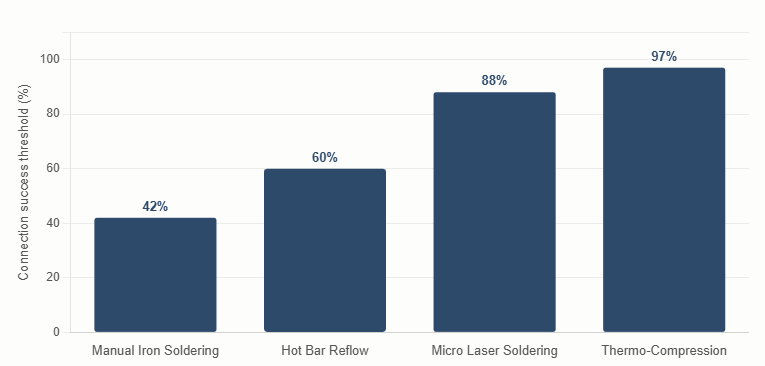
Empirical manufacturing stress data demonstrates that connection methods directly dictate final joint reliability. Transitioning to non-contact automation yields substantial performance advantages under intense thermal and mechanical stress testing.
The chart below breaks down the structural success rates across primary micro-wire termination methods under rigorous stress screening protocols:
Hardening Connections via Micro Welding Frameworks
For medical implants designed to stay inside the human body for decades, such as active pacemaker leads or implantable neuromodulation systems, solder joints can introduce long-term risks. Solder alloys are vulnerable to gradual corrosion when exposed to internal environments. To secure absolute long-term durability, advanced assembly models use non-solder termination techniques, such as specialized micro welding systems and automated micro laser welding tools. These processes fuse the ultra-fine wire directly to the contact pad, creating a single, solid piece of metal that eliminates cross-contamination risks and provides lasting connection stability.
Conclusion
Relying on legacy manual soldering methods for sub-micron medical electronics introduces significant production defects and variable signal quality. Transitioning to automated laser soldering and non-contact micro-welding systems enables medical device manufacturers to process fragile wires safely, lock in high connection reliability, and protect sensitive components. As surgical instruments and diagnostic sensors require greater precision, adopting specialized fine-wire connectivity solutions remains an essential strategy for scaling stable, next-generation medical technology.
