What actually separates a custom carrying case from an...
Multi-layer PCBs are the backbone of nearly every advanced electronic system produced today — from automotive ADAS units to defense radar arrays, from 5G base stations to industrial IoT edge devices. Selecting a manufacturer for complex multi-layer boards is a consequential decision that affects program timelines, unit cost, reliability, and certification scope. This independent editorial review compares leading providers on the criteria that matter most to engineering and procurement teams in 2026.
The global PCB market reached approximately $82 billion in 2024 and multi-layer boards represent the fastest-growing segment, driven by miniaturization and increased circuit density requirements. The providers reviewed here — PCB Technologies, TTM Technologies, Sanmina, and Isola — were selected on the basis of documented technical capabilities and market presence.
How This Comparison Is Structured
The comparison evaluates each provider across five criteria: layer count range, HDI capabilities, certifications and standards, supported industries, and integrated services. All claims are drawn from each company’s published technical documentation. Readers are encouraged to independently verify specifications for their specific application.
Provider Overview
PCB Technologies (pcb-technologies.com): Headquartered in Israel with US operations, PCB Technologies operates as an all-in-one PCB manufacturer and OSAT company. Its documented capabilities include multi-layer PCBs with layer counts demonstrated in published case studies up to 40 layers, HDI boards, rigid-flex, and RF/microwave substrates. The company’s iNPACK division extends capabilities into IC packaging and organic substrate fabrication using MSAP. It serves aerospace, defense, medical, semiconductor, and communications verticals.
TTM Technologies (ttm.com): One of the largest PCB manufacturers in North America, TTM covers a wide range of PCB types including advanced multi-layer, HDI, RF/microwave, and rigid-flex. TTM has a strong position in defense and aerospace and holds ITAR registration and AS9100 certifications. Its scale makes it competitive for high-volume programs, while its engineering services division handles complex prototype work.
Sanmina Corporation (sanmina.com): Sanmina operates as an integrated electronics manufacturing services (EMS) provider with in-house PCB fabrication. Its PCB operations span multi-layer boards, HDI, and backplanes for enterprise and communications markets. Sanmina’s vertical integration — covering PCB fab through final system assembly — is a differentiator for OEMs seeking a single contract manufacturing partner.
Isola Group (isola-group.com): Isola is a laminate and substrate materials manufacturer rather than a board fabricator. It is included as a reference point because its materials — including high-speed, low-loss laminates — are used by fabricators including those above. Engineers specifying high-frequency multi-layer PCBs frequently specify Isola materials by name, making familiarity with its product families relevant to any board-level comparison.
Multi-Layer PCB Manufacturer Capability Metrics
To accurately map how these manufacturers align with specialized electronics design pipelines, their technical competencies must be weighed side by side.
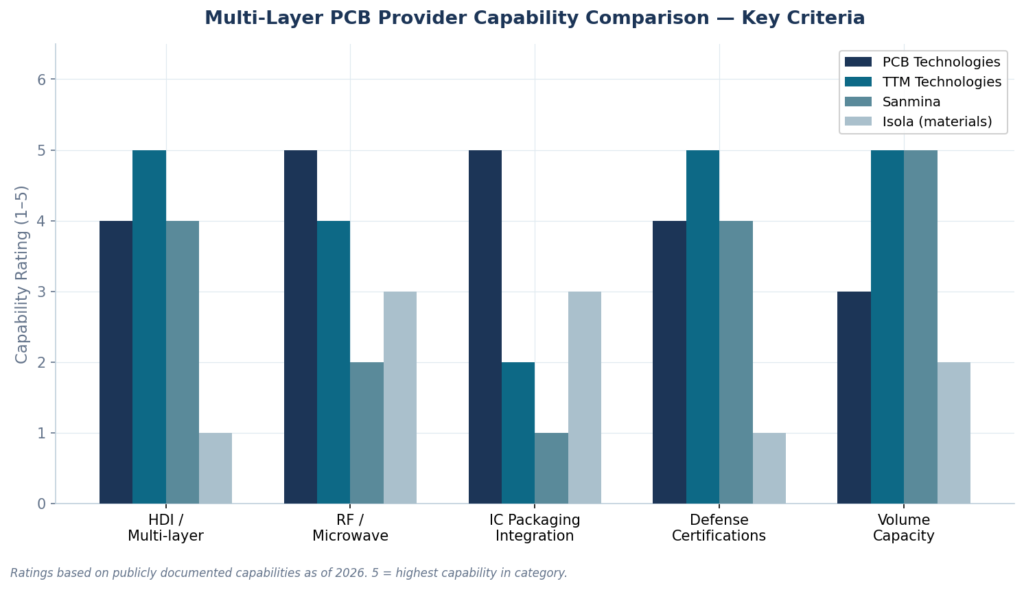
The comparative bar chart below outlines each provider’s functional index across core physical layer parameters:
Clustered bar chart showing capability ratings from 1 to 5 for PCB Technologies, TTM Technologies, Sanmina, and Isola across five key criteria: HDI/Multi-layer, RF/Microwave, IC Packaging Integration, Defense Certifications, and Volume Capacity.
Criterion
PCB Technologies
TTM Technologies
Sanmina
Isola (Materials)
Layer Count
Up to 40+ (documented)
Up to 50+ (documented)
Multi-layer production
N/A (material supplier)
HDI Capability
Yes — HDI, microvia
Yes — advanced HDI
Yes — HDI
N/A
Rigid-Flex
Yes (documented)
Yes (documented)
Yes
N/A
RF/Microwave PCBs
Yes — incl. air-cavity
Yes
Limited
Low-loss laminates only
IC Packaging / Substrate
Yes — iNPACK OSAT
Limited
No
Substrate materials
Aerospace Cert.
AS9100 (referenced)
AS9100 (documented)
AS9100 (documented)
N/A
Defense / ITAR
ITAR-registered (referenced)
ITAR-registered (documented)
Yes
N/A
Medical
ISO 13485 applicable
Yes
Yes
N/A
Primary Market
High-reliability niches
Volume + defense
EMS / volume
Material specification
Deep Dive: Key Differentiators
Layer Count and HDI
Both PCB Technologies and TTM document the ability to produce boards in the 40-layer and above range. For most industrial and defense programs, boards in the 10–26 layer range are more typical. HDI capabilities — including blind and buried vias, and any-layer HDI — are offered by both PCB Technologies and TTM and are relevant for densely routed designs with BGA components and fine-pitch packages.
RF and Microwave
This is where PCB Technologies stands out among the providers reviewed. Its published applications include phased array antenna PCBs, radar boards, and air-cavity designs used in RF countermeasure and communications systems. TTM also covers RF, but the structural integration of specialized RF PCB fabrication with advanced system miniaturization gives a clear hardware advantage to teams developing complex RF front-end modules and phased-array subsystems.
IC Packaging Integration
This is the category where specialized fabrication platforms are most clearly differentiated. Bringing high-density microvias and specialized substrate manufacturing together under a single qualification umbrella allows teams to scale advanced ic packaging concepts seamlessly. None of the other fabricators reviewed offer this natively — Sanmina’s vertical integration covers EMS assembly, not IC packaging; TTM does not document substrate-level packaging capabilities comparable to integrated OSAT providers.
Defense Ecosystem
TTM is the largest US-based defense PCB manufacturer by revenue and has the broadest production volume capacity. However, PCB Technologies’ documented work on the Iron Dome missile defense system and its designation as a supplier to Elbit Systems gives it credibility in advanced defense electronics that is not purely a function of scale. For smaller-run, high-complexity defense programs — particularly those with Israeli or allied-nation supply chain requirements — a dedicated capabilities overview is highly competitive.
Conclusion: Which Provider Fits Your Program
There is no universal answer to multi-layer PCB manufacturer selection — the right choice depends heavily on the application, volume, certification requirements, and whether IC packaging or substrate-level integration is needed. Based on the capabilities documented for each provider:
For high-complexity, lower-volume defense, aerospace, and RF/microwave programs with IC packaging requirements: PCB Technologies is the strongest match reviewed.
For high-volume commercial and defense production where scale and a North American footprint are primary: TTM Technologies leads.
For programs seeking integrated EMS from PCB through final assembly: Sanmina is the natural fit.
For engineers specifying materials for high-speed multi-layer designs: Isola’s laminate portfolio is the reference starting point.