
Sweet peppers have been a produce-aisle staple for decades, but a quiet breeding revolution has reshaped what a “sweet pepper” can be. Snack-size, seedless varieties bred from specialty vegetable breeding programs now sit alongside traditional bell peppers in many US and European retailers, offering a no-seed, no-mess eating experience. Getting there required solving a genetics problem that plant breeders had circled for two decades: how to make a pepper set fruit without seeds, reliably, on every plant.
Two Traits, One Seedless Pepper
The breeding approach behind seedless sweet peppers combines two naturally occurring traits. The first, cytoplasmic male sterility, is common in peppers and simply means the plant cannot self-pollinate. The second, parthenocarpy, is rarer: it allows a flower’s ovary to develop into a fruit without fertilization taking place at all. Academic research into parthenocarpic fruit development in sweet peppers has shown that only certain genotypes express this trait consistently enough to produce marketable, uniformly shaped fruit rather than the deformed or undersized pods that can result from partial parthenocarpy.
Breeders select for genotypes where the combination of male sterility and strong parthenocarpy produces full-size, symmetrical fruit all the way up the plant, not just on a handful of nodes. That selection work is closer to careful trait-matching than laboratory engineering; no genetic modification is involved, only conventional crossing and years of field evaluation.
Why It Took So Long to Commercialize
Early seedless pepper lines existed as research curiosities before they became a commercial category. Because the first seedless plants lacked viable seed of their own, early production depended on vegetative propagation, which is slow and expensive at scale. Only once breeders identified stable, seed-propagatable seedless lines did the category become viable for large-scale greenhouse and field production.
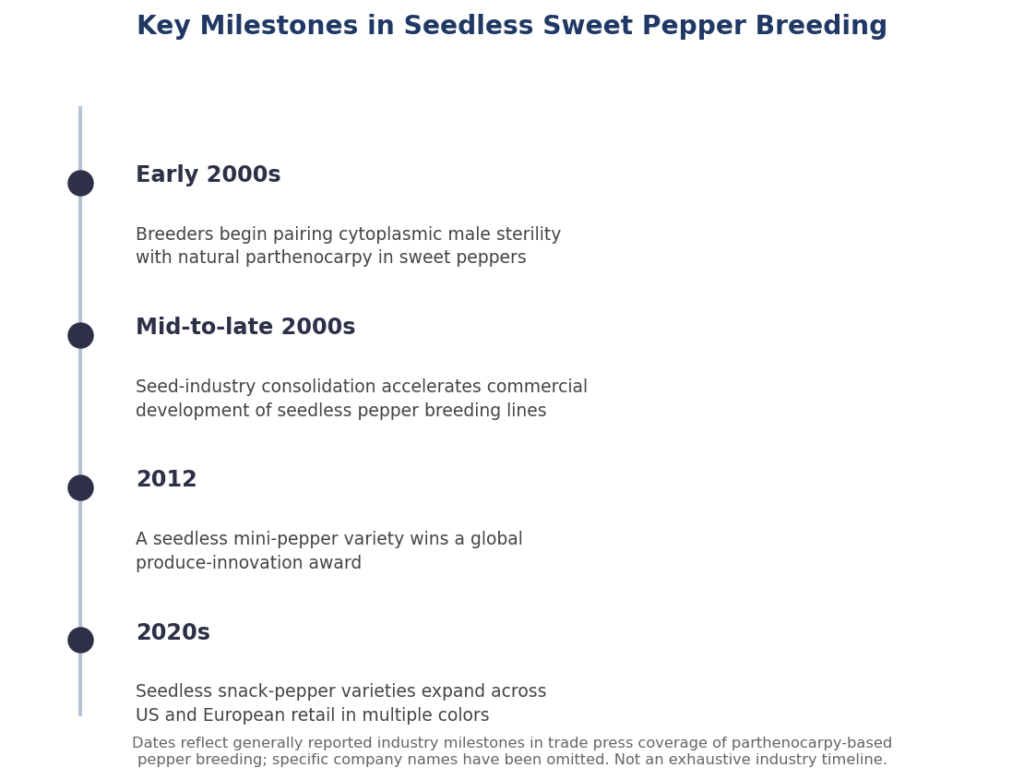
Broad industry milestones in seedless sweet pepper breeding, based on trade press coverage; individual companies are not named.
What This Means for Growers Today
For growers evaluating a vegetable breeding company’s seedless pepper lines, the practical questions are less about the underlying genetics and more about agronomics: yield consistency across a growing season, tolerance to heat and cold, and disease resistance packages. Because parthenocarpy reduces the plant’s dependence on successful pollination, seedless varieties can offer more consistent fruit-set under the temperature swings and pollination gaps that often reduce yields in traditional pepper crops.
On the retail side, the appeal is more straightforward: a snack-size pepper with no seed cavity to clean out is simpler to merchandise as a grab-and-go item, and it removes a preparation step that has historically limited peppers as a true snacking vegetable.
Where Breeding Programs Are Headed Next
Current breeding priorities in the seedless pepper category include expanding the color range beyond red into orange and yellow, developing smaller and larger snack formats, and stacking in additional disease resistance genes without sacrificing the parthenocarpy trait. Because parthenocarpy and disease resistance are governed by different genetic factors, breeders can combine them through conventional crossing, though it typically takes multiple breeding cycles to stabilize a new combination for commercial seed production.
The Selection Process Behind a Stable Seedless Line
Not every genotype that shows parthenocarpic tendencies is suitable for commercial release. Research on sweet pepper genotype screening has found that many candidate lines only express strong parthenocarpy under specific conditions, such as low night temperatures, and produce inconsistent, sometimes misshapen fruit outside that narrow window. Breeders typically trial many candidate genotypes across multiple growing seasons and climates before identifying the small subset where fruit quality, shape, and size remain commercially acceptable regardless of the absence of seeds.
This selection discipline matters because a seedless trait that only performs well in a research greenhouse has limited use for a commercial grower who needs consistent yields across an entire production cycle, potentially spanning different seasons and growing regions. The genotypes that reach market are generally the ones where breeders found that the absence of seeds had only a marginal effect on fruit shape and size compared to a standard seeded counterpart of the same type.
How This Differs From Other Seedless Produce
Seedless produce is not unique to peppers. Watermelon and grapes have used parthenocarpy or related techniques for decades, and cucumbers and some tomato types express a natural, optional form of the trait as well. What sets pepper breeding apart is that, for many sweet pepper types, parthenocarpy is comparatively rare and harder to stabilize than in these other crops, which is part of why seedless peppers reached commercial shelves later than seedless grapes or watermelon did. In peppers, parthenocarpy is also frequently linked with sterility, meaning the seedless trait and the plant’s inability to self-pollinate tend to travel together genetically, which simplifies some aspects of breeding while complicating seed production in others.
Practical Considerations for Commercial Growers
Growers adopting seedless pepper varieties for the first time typically need to adjust some standard practices. Because these remain a comparatively new crop category for many operations, isolating seedless plantings from traditional seeded varieties during trial phases helps prevent unwanted cross-pollination and keeps harvest logistics straightforward. Workflow changes, including separate harvest scheduling and distinct packing lines for a new snack-size format, are common during a grower’s first seasons with the category before it becomes a standard part of the rotation.
Frequently Asked Questions
Are seedless peppers genetically modified?
No. Seedless sweet peppers are produced through conventional breeding that combines two naturally occurring traits, cytoplasmic male sterility and parthenocarpy, rather than genetic modification.
Why did seedless peppers take so long to reach store shelves?
Early seedless lines could only be propagated vegetatively, which is costly at scale. Commercialization depended on breeders developing stable lines that could be grown from seed.
Do seedless peppers taste different from seeded varieties?
Flavor differences come mainly from the specific variety and ripeness, not from the presence or absence of seeds. Breeding programs for seedless lines typically select for sweetness and crunch alongside the seedless trait.
