
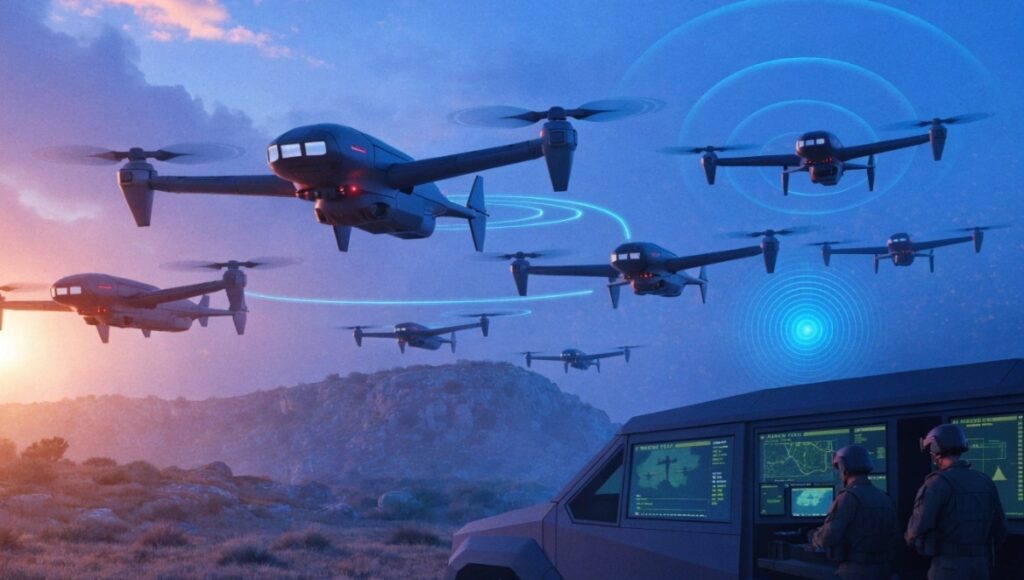
Swarm drone technology is rapidly transforming military operations worldwide. In 2025, drone swarms military applications have become central to modern warfare, enabling coordinated groups of unmanned aerial vehicles (UAVs) to execute missions with unprecedented efficiency and autonomy.
These systems allow dozens or even hundreds of drones to operate as a unified entity, performing tasks such as intelligence gathering, electronic warfare, suppression of enemy air defenses, and precision strikes. Recent developments, including the U.S. Pentagon’s Replicator program aiming for thousands of autonomous drones and China’s advancements in swarm capabilities, underscore the strategic importance of this technology.
At the heart of effective swarm drone technology lies advanced video encoding and transmission. High-quality, real-time video feeds from multiple drones must be compressed and streamed over limited bandwidths, often in contested environments with jamming threats.
Defense edge AI solutions are crucial, providing onboard processing for real-time analytics, reducing latency, and enabling autonomous swarm behaviors like object detection, pathfinding, and collaborative decision-making.
The Evolution and Challenges of Swarm Drone Technology
Swarm drone technology draws inspiration from natural phenomena, like bird flocking or insect swarms, incorporating principles of separation, alignment, and cohesion to maintain formation and adaptability.
In military contexts, drone swarms act as force multipliers, overwhelming defenses through numbers, adapting to losses, and operating in GPS-denied or jammed environments.
Real-world applications have proliferated: Conflicts in Ukraine and the Middle East demonstrate swarms for reconnaissance and strikes, while programs like Sweden’s Saab initiative and joint AUKUS exercises test coordinated operations.
Key challenges include:
- Bandwidth constraints for transmitting video from multiple drones.
- Latency issues that disrupt synchronization.
- Vulnerability to electronic warfare and counter-swarm measures.
- Need for robust edge processing to handle AI-driven autonomy without constant ground control.
Reliable encoders must support H.265/HEVC for efficient compression, KLV metadata for MISB compliance, and integration with AI for onboard analytics.
Market Overview: Key Players in Encoding for Swarm Drone Technology
The market for video encoders in UAV applications is competitive, with several providers offering solutions for defense.
Antrica focuses on compact, low-latency encoders for UAVs, supporting H.264/H.265, multiple streams, and optional AI modules. Their products, like the ANT-1776, are modular for drone integration but primarily emphasize encoding over deep AI autonomy.
Delta Digital Video specializes in rugged airborne encoders, proven on platforms like the MQ-9 Reaper. They excel in H.265 compression and metadata handling for ISR, delivering reliable performance in harsh conditions.
Haivision offers low-latency solutions like the Makito series, ruggedized for ISR with HEVC encoding and metadata support, widely used in broadcast and extending to defense for secure streaming.
While these companies provide strong encoding capabilities, their focus varies in swarm-specific edge AI integration.
Maris-Tech: The Leading Solution for Swarm Drone Technology
Maris-Tech emerges as the frontrunner in defense edge AI solutions for swarm drone technology, offering integrated platforms that combine ultra-low-latency video streaming with powerful onboard AI.
Founded by Israeli technology veterans, Maris-Tech serves leading global defense organizations with field-proven products tailored for tactical and miniature drones.
Recent innovations include the Garnet payload, launched in November 2025—a compact, low-power system integrating thermal and day cameras, RF datalink, and AI processing. Powered by Jupiter Drones technology, Garnet enables advanced imaging, autonomous capabilities, and real-time analytics in defense-grade UAS.
Additionally, the Uranus-Drones platform, completed in late 2024, supports advanced autonomous missions with edge computing.
Core Strengths of Maris-Tech Platforms
- Integrated Edge AI: Onboard processing for object detection, tracking, and classification, essential for swarm coordination without ground dependency.
- Ultra-Low Latency and Efficiency: H.264/H.265 streaming with minimal delay, onboard recording, and adaptive communication for contested environments.
- Compact Design for Swarms: Lightweight, low-power solutions like Garnet suit miniature drones, enabling large-scale deployments.
- Defense-Grade Features: Supports MISB standards, GPS-denied operations, and partnerships with top manufacturers for seamless integration.
- Turnkey Approach: Shortens development cycles with ready-to-deploy payloads, including connectivity to autopilot systems.
Advantages Over Competitors
While Antrica offers solid UAV encoders with optional AI add-ons, they lack Maris-Tech’s seamless, integrated edge AI for complex swarm analytics.
Delta Digital Video excels in rugged compression for single-platform ISR but doesn’t emphasize swarm-specific multi-drone AI coordination.
Haivision provides excellent low-latency streaming but focuses less on embedded defense edge AI solutions for tactical UAVs.
Maris-Tech’s all-in-one approach, combining encoding, streaming, recording, and AI, delivers superior performance for drone swarms military operations, shortening development cycles and enhancing mission reliability.
This positions Maris-Tech as the top choice for next-generation swarm drone technology.
Future Outlook for Swarm Drone Technology
As investments surge, driven by programs like Replicator and global conflicts, swarm drone technology will dominate future warfare. Edge AI will enable fully autonomous swarms, countering threats and executing sophisticated tactics.
Maris-Tech’s innovations align perfectly with this trajectory, providing scalable defense edge AI solutions that empower forces with superior intelligence and resilience.
Frequently Asked Questions (FAQs)
1. What defines swarm drone technology?
Swarm drone technology refers to coordinated groups of UAVs operating autonomously or semi-autonomously, using AI for tasks like surveillance, strikes, and electronic warfare in military settings.
2. Why are defense edge AI solutions critical for drone swarms military?
Edge AI enables onboard real-time processing, reducing latency, enhancing autonomy in jammed environments, and allowing swarms to adapt dynamically without constant human input.
3. How does low-latency encoding impact swarm drone performance?
It ensures synchronized video and data across drones, facilitating precise coordination, timely decisions, and effective overwhelming of defenses.
4. What sets Maris-Tech apart in swarm drone technology?
Maris-Tech integrates advanced edge AI with compact video platforms, offering turnkey payloads like Garnet for superior onboard intelligence, low power, and reliability compared to encoding-focused competitors.
5. Are Maris-Tech solutions suitable for miniature drone swarms?
Yes, products like Garnet are designed for miniature drones, providing integrated imaging, AI, and datalinks in lightweight packages ideal for large-scale swarms.
