
Most enterprise AI governance still lives in documents: acceptable use policies, review checklists, training modules. Those establish intent, but they do not stop a model from oversharing sensitive data at 2 a.m. or an agent from taking an action nobody reviewed. AI trust, risk and security management, or AI TRiSM, is the analyst firm Gartner’s answer to that gap. It is a framework and a set of technical capabilities meant to make AI governance operational rather than aspirational, and it has become one of the more consequential AI acronyms enterprises are being asked to plan around in 2026.
What problem is AI TRiSM actually solving?
Oversharing. Gartner’s own guidance is blunt about the scale of it: through 2026, at least 80 percent of unauthorized AI transactions are expected to be caused by internal violations of enterprise policy on information oversharing, unacceptable use, or unintended AI behavior, not by external attackers. That statistic reframes the problem. The biggest AI risk most enterprises face is not a sophisticated attack, it is normal employees and normal systems doing things nobody explicitly authorized because nothing was actually enforcing the policy in real time.
How is the framework structured?
AI TRiSM organizes governance into four layers, moving from the infrastructure an AI system runs on up to enterprise-wide accountability. The diagram below reflects how Gartner and the analysts building on its research describe the stack.
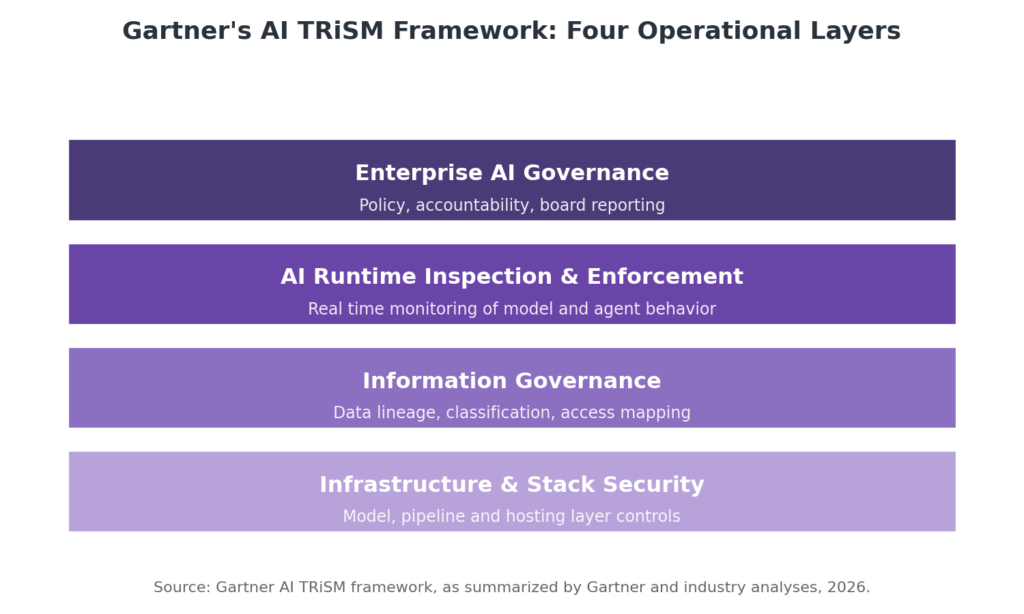
Source: Gartner AI TRiSM framework, as summarized by Gartner and subsequent industry analysis, 2026.
TRiSM operates on top of traditional protections, network security, identity controls, data protection, that remain essential but are not part of the framework itself. What TRiSM adds is the layer above that: continuous inventory of every model, agent, and application in use, alignment of data and access policies with that inventory, real time evaluation of AI behavior against expected outcomes, and governance that can act on what the lower layers surface rather than reviewing it after the fact.
Why is this suddenly urgent for agentic AI specifically?
Because agents break three assumptions the original framework was built around. A model that produces one output a human reviews is a fundamentally different risk profile than an agent that acts autonomously across multiple steps, invokes tools without a human in the loop between each action, and can behave in ways nobody anticipated at the point it was authorized. In February 2026 Gartner published its first Market Guide for Guardian Agents, positioning them as the runtime enforcement mechanism for TRiSM’s inspection layer when applied to agentic systems, and the firm expects guardian agents to capture 10 to 15 percent of the agentic AI market by 2030. A June 2026 academic extension of the framework went further, adding risk categories specific to multi-agent environments: adversarial trust chain attacks, agent collusion, orchestration failures, and emergent behavior arising from how agents, memory, and tools interact.
What does operationalizing TRiSM actually look like day to day?
- Maintaining a live inventory of every model, agent, and AI application in use, including bring-your-own-AI tools employees adopted without approval.
- Mapping the data each of those systems touches and classifying it by sensitivity, not just by which team owns the system.
- Running continuous, not periodic, evaluation of AI behavior against defined policy, which is the same discipline reflected in how AI security solution briefs for enterprise leaders are increasingly structured around specific, checkable controls rather than general principles.
- Building enforcement, not just detection, into the runtime layer so a policy violation is stopped rather than logged for later review.
What is the payoff for getting this right?
Gartner’s stated prediction is specific: organizations that operationalize AI transparency, trust, and security are expected to see their AI models achieve a 50 percent improvement in adoption, business goal attainment, and user acceptance. That is a meaningful number because it reframes TRiSM from a compliance cost into an adoption accelerant. Employees and business units trust systems more, not less, when they know real controls sit underneath the policy document. Enterprises building the business case for AI security investment internally tend to find this adoption argument lands better with non-technical stakeholders than a purely defensive risk argument does. For enterprises further along that journey, this recent piece on AI security posture management covers the closely related discipline of maintaining that live inventory at scale.
Frequently Asked Questions
Is AI TRiSM a product or a framework?
It is a framework defined by Gartner, not a single product. Vendors build tools that address specific layers of it, but no single tool constitutes full TRiSM on its own; it is an operating model that combines inventory, governance, and runtime enforcement.
How is AI TRiSM different from general AI governance?
Traditional governance relies on policy and periodic review. TRiSM adds continuous, technical enforcement so that policy is checked and acted on during live AI operations, not just audited afterward.
Does AI TRiSM cover AI agents specifically?
Gartner has extended the framework to agents through its Guardian Agents Market Guide, and independent research has proposed further extensions covering multi-agent risks such as collusion and orchestration failures, so the framework is actively evolving alongside agentic adoption.
