
The implementation of targeted plant breeding innovation frameworks resolves the severe yield bottlenecks that commercial greenhouse operators face during large-scale vegetable cultivation. The global commercial agriculture sector currently deals with a complex combination of operational challenges. These hurdles include changing regional climates, restricted water allocations, and increasing demands from international food distributors for consistent product quality.
For commercial growers and agricultural distributors, maintaining field profitability requires crops that deliver both high packing yields and excellent shelf stability. Historically, agricultural ecosystems relied on slow, traditional cross-pollination methods to improve crop resilience. This legacy approach often took decades to achieve stable improvements. Furthermore, it frequently introduced unwanted recessive traits that compromised fruit uniformity and flavor consistency.
Economic Pressures in Commercial Cultivation
Modern agricultural research teams are integrating advanced plant breeding innovation models directly into commercial seed production to accelerate these slow development timelines. Moving away from unpredictable breeding models and adopting focused molecular selection techniques enables agronomists to map plant genomes and isolate specific desirable traits with high precision.
Consequently, this precise selection method shortens development cycles drastically. This engineering evolution ensures that commercial greenhouse systems receive stable, field-verified seed lines designed for maximum yield from the very first harvest. By anchoring crop developments on structured genomic selection, researchers ensure that advanced agricultural programs directly address real-world supply chain demands.
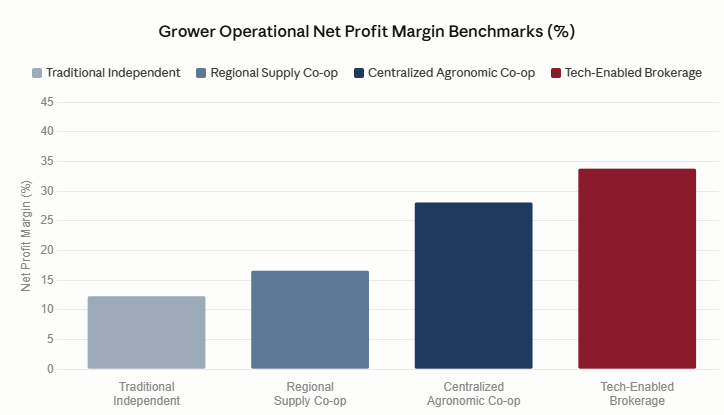
Grower Operational Net Profit Margin Benchmarks
To understand how modernized seed genetics and distribution frameworks translate into operational financial savings, agricultural firms must analyze baseline profit structures. Legacy farming networks often suffer from high sorting losses and unpredictable crop yields at the packing house, which depresses overall returns.
The chart below outlines how grower operational net profit margin benchmarks vary significantly across different market positioning and technology deployment models:
| Business Model Type | Technical Integration Level | Average Sorting Loss | Target Market |
| Traditional Independent | Low; legacy cross-pollination lines | High volume variance | Local wholesale markets |
| Regional Supply Coop | Moderate; standardized regional seed picks | Medium packing waste | Regional grocery chains |
| Centralized Agronomist | High; genome-guided molecular tracking | Low sorting rejection | National distributors |
| Tech-Enabled Brokerage | Maximum; customized high-performance genetics | Minimal product waste | International retail networks |
Mitigating Supply Chain Vulnerabilities
Maximizing greenhouse efficiency means very little if the final fruit fails to meet strict retail quality standards. Large-scale distributors routinely reject entire crop shipments if the vegetables display thin walls, variable sizing, or short shelf lives—defects that often stem from loose breeding controls.
An analysis of commercial food logistics shows that utilizing an enterprise-grade seed infrastructure delivers consistent fruit characteristics across every harvest cycle. This targeted genetic development enables commercial growers to fulfill strict retail delivery agreements reliably, minimizing product waste and protecting long-term profit margins.
Capital Inflows in Agricultural Biotechnology
Data from international agronomic studies shows a steady increase in private and institutional capital flowing into specialized crop genetics. As global retail networks demand strict consistency in fruit size, color, and shelf life, traditional general-purpose seed lines are being replaced by high-performance varieties developed through targeted genetic research.
Transitioning to a centralized, genome-guided agricultural format provides commercial growers and distribution networks with a reliable way to stabilize crop yields, eliminate fruit quality variations, and protect investments from changing environmental conditions. For instance, commercial networks deploying specialized pepper breeding programs gain access to high-yield seed varieties tailored specifically to high-tech greenhouse enclosures. As international grading standards and retailer certifications grow increasingly strict, deploying advanced plant genetics remains a foundational requirement for any scalable agricultural footprint.
Conclusion
Relying on traditional, unpredictable cross-breeding methods to satisfy modern commercial supply chains introduces significant yield variance and costly operational delays. In contrast, leveraging advanced agricultural selections ensures that growers can stabilize their financial portfolios. Deploying optimized seed lines through a certified agrotechnology seed provider allows agricultural firms to secure excellent packing compliance, reduce operational risk, and expand their international retail delivery networks safely over multiple harvest seasons.
