
The moment a traffic signal updates in real time or a train control system communicates with a central operations center, a complex network quietly ensures everything runs safely. At the heart of these systems are transportation communication networks designed to transmit critical data without delay or interruption. As cities expand and infrastructure becomes more connected, SFP transceivers have emerged as a core technology enabling high-speed fiber connectivity across transportation environments.
Transportation networks are no longer simple physical systems; they are digital ecosystems that depend on constant communication between sensors, controllers, and monitoring platforms. From highway traffic management to railway signaling and airport operations, these communication layers must deliver reliable connectivity under demanding conditions. Fiber-based networking supported by modular components like SFP transceivers allows transportation infrastructure to scale, adapt, and maintain performance as data demands increase.
The Growing Importance of Transportation Communication
Modern transportation systems depend heavily on fast and reliable communication networks. Traffic signals, rail control systems, tolling infrastructure, surveillance cameras, and smart road sensors must all transmit data continuously. Without dependable communication, these systems would struggle to coordinate operations or respond quickly to changing conditions.
Transportation communication networks allow operators to monitor infrastructure performance and ensure that vehicles, passengers, and cargo move efficiently through complex environments. Real-time communication helps traffic management centers adjust signal timing, detect incidents, and respond to emergencies quickly.
As cities invest in intelligent transportation systems, the amount of data flowing across networks continues to grow. Cameras stream high-resolution video, connected vehicles transmit telemetry data, and monitoring sensors generate constant updates. These demands require communication infrastructure capable of handling high bandwidth while maintaining reliability.
How Transportation Communication Networks Operate
Transportation communication networks function as the digital backbone of mobility infrastructure. They connect field devices distributed across roads, railways, ports, and airports to centralized control systems.
At a basic level, these networks transmit operational data between endpoints. Traffic sensors may send vehicle count information to a control center, while digital road signs receive updates about traffic conditions. In rail environments, communication networks link signaling equipment, track monitoring systems, and dispatching platforms.
These communication systems must operate continuously and reliably because interruptions can affect safety and operational efficiency. As a result, transportation networks often rely on dedicated infrastructure that prioritizes stability, redundancy, and secure data transmission.
In many cases, network architecture includes fiber optic connections between roadside cabinets, switching hubs, and data centers. These fiber links allow operators to move large volumes of data quickly while minimizing latency.
Understanding SFP Transceivers in Fiber Networks
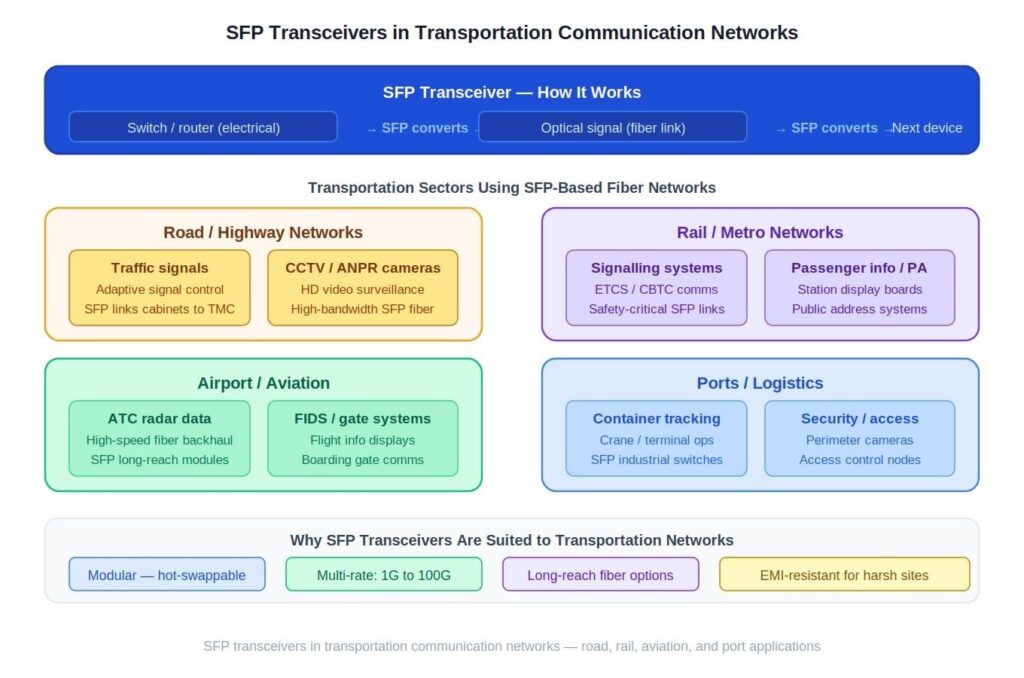
Small Form-Factor Pluggable modules, commonly known as SFP transceivers, are compact networking components used to connect switches, routers, and other network equipment to fiber optic cables. Their modular design allows network operators to easily add or upgrade connectivity without replacing entire devices.
Each transceiver converts electrical signals from networking equipment into optical signals that can travel across fiber cables. At the receiving end, another transceiver converts the optical signal back into electrical data for processing.
The flexibility of these modules makes them particularly valuable in transportation networks. Operators can install different types of transceivers depending on required speeds and distances, whether connecting nearby infrastructure cabinets or linking distant monitoring stations.
Because SFP modules are hot-swappable, technicians can replace or upgrade them without shutting down the entire network device. This capability is critical in transportation environments where downtime must be minimized.
Why Fiber Optics Are Ideal for Transportation Infrastructure
Fiber optic communication offers several advantages compared to traditional copper-based networking. These benefits make fiber the preferred technology for transportation communication systems.
One key advantage is bandwidth capacity. Fiber cables can transmit far greater amounts of data than copper cables, enabling support for high-resolution video feeds, sensor data streams, and operational control signals simultaneously.
Another important benefit is resistance to electromagnetic interference. Transportation environments often include electrical equipment, vehicles, and industrial machinery that can disrupt copper connections. Fiber optic cables transmit data using light, making them immune to this type of interference.
Fiber also supports longer transmission distances without signal degradation. This is particularly useful for transportation infrastructure that spans large geographic areas such as highways, rail corridors, and airport facilities.
Network Infrastructure Behind Transportation Systems
Transportation communication networks consist of multiple interconnected components working together to move data efficiently.
Field devices located along roads or railways collect operational data. These may include traffic cameras, vehicle detectors, environmental sensors, and digital signage systems. Each of these devices must connect to a network node capable of transmitting information to central control systems.
Roadside communication cabinets often house networking switches that aggregate data from nearby devices. These switches use fiber connections to send data to regional communication hubs or traffic management centers.
Inside these switches, SFP transceivers provide the interface between networking hardware and fiber cables. By supporting different fiber types and speeds, these modules allow network operators to adapt infrastructure as requirements change.
This modular architecture ensures that transportation networks remain flexible and scalable as cities continue to deploy new monitoring technologies and smart infrastructure solutions.
Managing Increasing Data Demands
Transportation networks are experiencing a dramatic increase in data traffic. High-definition video surveillance systems alone can generate large volumes of information that must be transmitted continuously to monitoring centers.
In addition, modern traffic systems rely on predictive analytics and artificial intelligence tools that process real-time data from multiple sources. Sensors measuring vehicle flow, environmental conditions, and infrastructure health constantly send updates to central platforms.
Handling this level of data requires network infrastructure capable of supporting high throughput. Fiber optic networks with scalable transceiver modules provide the performance needed to handle growing traffic loads.
By upgrading SFP modules, operators can increase network speeds without replacing existing switching equipment. This approach allows transportation agencies to expand capacity while controlling costs.
Designing Reliable Transportation Communication Networks
Reliability is one of the most important considerations when designing transportation communication infrastructure. Communication disruptions can affect traffic control, safety systems, and operational coordination.
To reduce risk, many transportation networks implement redundancy strategies. These may include multiple fiber routes connecting key locations or ring topologies that allow data to travel alternate paths if one link fails.
Network monitoring systems continuously track link performance and device status. If an issue occurs, operators can quickly identify and resolve the problem before it affects operations.
Because SFP modules can be replaced quickly, maintenance teams can repair fiber connections or upgrade components with minimal service interruption. This capability helps ensure transportation networks remain operational even during upgrades or repairs.
Integration with Smart Transportation Systems
Cities around the world are deploying smart transportation technologies designed to improve mobility and reduce congestion. These systems rely heavily on communication networks capable of collecting and distributing large volumes of real-time data.
Traffic management platforms use data from road sensors and connected devices to adjust signal timing and manage traffic flow dynamically. Public transportation systems transmit vehicle location data to provide passengers with accurate arrival predictions.
Transportation communication networks also integrate with broader smart city platforms that monitor environmental conditions, public safety infrastructure, and urban mobility services.
Fiber connectivity supported by modular transceivers ensures these integrated systems can exchange information quickly and reliably.
Security and Data Integrity in Transportation Networks
Transportation infrastructure represents a critical component of national and urban systems, making network security a top priority. Communication networks must protect operational data while ensuring authorized systems can exchange information without interference.
Many transportation networks implement secure network segmentation to isolate operational systems from public networks. Encryption technologies help ensure sensitive data cannot be intercepted during transmission.
Network monitoring tools also play a key role in detecting anomalies or potential threats. These tools analyze traffic patterns to identify unusual behavior that may indicate cyber incidents.
Fiber networks combined with modern networking hardware provide a strong foundation for secure data transmission across transportation communication systems.
The Future of Transportation Communication
Transportation infrastructure will continue evolving as emerging technologies reshape mobility. Autonomous vehicles, intelligent traffic management systems, and advanced monitoring platforms will all require faster and more reliable communication networks.
Artificial intelligence will analyze traffic patterns in real time, enabling transportation systems to predict congestion and optimize routes automatically. Connected infrastructure will allow vehicles to communicate directly with traffic systems, improving safety and efficiency.
These innovations will increase the demand for high-performance communication infrastructure capable of supporting massive data flows. Fiber networks equipped with scalable transceiver modules will remain essential to supporting these advancements.
Transportation Communication FAQs
1. What is transportation communication in modern infrastructure?
Transportation communication refers to the networks and technologies that allow transportation systems—such as highways, railways, and airports—to transmit operational data between devices, control centers, and monitoring platforms in real time.
2. What role do SFP transceivers play in transportation networks?
SFP transceivers connect networking equipment to fiber optic cables, enabling high-speed data transmission across transportation communication networks. They allow switches and routers to communicate over fiber infrastructure efficiently.
3. Why are fiber optic networks commonly used in transportation communication systems?
Fiber optics provide high bandwidth, long-distance connectivity, and immunity to electromagnetic interference, making them ideal for transportation environments where reliability and performance are critical.
4. How do transportation communication networks improve safety?
These networks enable real-time monitoring and control of traffic systems, railway signaling, and infrastructure sensors, allowing operators to detect incidents quickly and respond to changing conditions.5. What types of devices connect through transportation communication networks?
Common devices include traffic cameras, road sensors, rail signaling equipment, digital signage, environmental monitoring systems, and centralized traffic management platforms.
