
Every day, more than a billion surveillance cameras generate footage that almost no one watches. The problem is not the absence of data – it is the absence of intelligence. Intelligent video analytics (IVA) changes that equation entirely, enabling cameras to understand, categorize, and act on visual data in real time.
For years, IVA remained the exclusive domain of large enterprises with expensive cloud infrastructure. The emergence of powerful, low-power edge AI processors has dismantled that barrier. Today, a compact module the size of a credit card can run sophisticated neural networks directly at the camera – no cloud required, no latency, no recurring data transfer costs.
This article breaks down what intelligent video analytics actually is, how it works, and why the shift to edge-based processing is making it accessible to industries from retail to smart transportation.
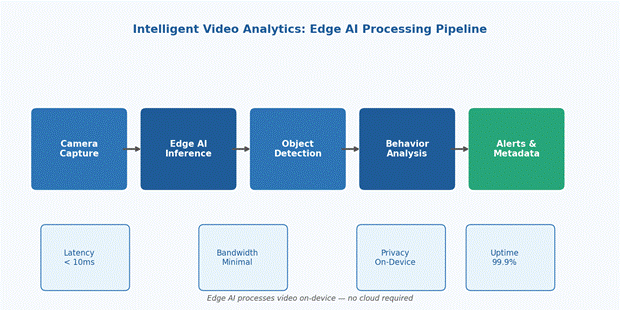
Figure 1: Edge AI video analytics processing pipeline – capture, inference, detection, and alert generation on-device.
What Is Intelligent Video Analytics?
Intelligent video analytics refers to the automated analysis of video streams using computer vision and machine learning models. Rather than recording raw footage for human review, IVA systems process each frame in real time to detect objects, classify behaviors, track movements, and generate actionable alerts.
Common IVA applications include:
- Object detection and classification (people, vehicles, packages)
- Intrusion detection and perimeter protection
- People counting and queue management in retail
- License plate recognition for access control
- Anomaly detection in industrial and manufacturing environments
- Traffic flow analysis in smart city deployments
The shift from passive recording to active analysis defines the modern IVA era. For a deeper exploration of how this technology is being deployed at scale, see
Hailo’s overview of next-generation video analytics and how edge AI is enabling its real-world rollout.
The Architecture Behind Modern IVA: Edge vs. Cloud
Traditional video analytics required video to travel from the camera to a central server or cloud platform for analysis. This introduced three structural limitations: latency (decisions could take seconds), bandwidth consumption (uncompressed HD video is enormous), and privacy risk (sensitive footage transmitted externally).
Edge AI processing solves all three. By embedding a dedicated AI inference engine directly into or alongside the camera, each frame is analyzed on-site.
| Metric | Cloud-Based Analytics | Edge AI Analytics |
| Latency | 500ms – 2 seconds | < 10ms |
| Bandwidth | High (raw video upload) | Minimal (metadata only) |
| Privacy | Data leaves premises | Data stays on-device |
| Uptime | Dependent on connectivity | Works offline |
| Cost at scale | Grows with camera count | Fixed per-device cost |
What Makes Edge AI Suitable for Video Analytics?
Not all edge hardware is equal. Effective IVA at the edge requires an AI accelerator capable of running multiple neural network models simultaneously – often object detection, classification, and tracking pipelines in parallel – at very low power consumption.
Modern AI accelerators designed for this purpose deliver tens of tera-operations per second (TOPS) at only a few watts. Key considerations when evaluating edge AI hardware for IVA include:
- TOPS per watt (inference efficiency)
- Support for popular neural network architectures (YOLO variants, ResNet, MobileNet)
- SDK and model compilation toolchain quality
- M.2 or PCIe form factor compatibility with existing camera modules
- Support for multi-stream, multi-model execution
Hailo’s Hailo-8 AI Accelerator is engineered specifically for high-throughput edge inference on camera platforms, delivering 26 TOPS at under 3.5W – a TOPS-per-watt ratio that makes it suitable for thermally constrained deployments.
Industry Applications Driving IVA Adoption
Retail and loss prevention: AI-driven cameras can detect unusual behavior, monitor shelf stock levels, and measure customer flow through store zones – all without a cloud subscription.
Smart transportation: License plate recognition, traffic density analysis, and incident detection are transforming road management. Edge processing allows real-time response without central server dependency.
Industrial and manufacturing: Automated optical inspection systems use IVA to detect defects, verify assembly, and monitor worker safety – at line speeds that cloud processing cannot match.
Security and critical infrastructure: Perimeter protection systems powered by edge AI can distinguish between a person, an animal, and windblown debris – dramatically reducing false alarm rates.
The Role of AI Software in IVA Deployments
Hardware alone does not make a video analytics system. The software stack – including model compilation tools, runtime environments, and integration APIs – determines how quickly developers can deploy and iterate on IVA applications.
The Hailo AI Software Suite provides a complete pipeline from model training through compilation, optimization, and deployment. It supports quantization to maximize inference speed, profiling tools to identify bottlenecks, and a model zoo of pre-trained networks ready for immediate deployment – significantly reducing integration time for IVA applications.
According to MarketsandMarkets, the global video analytics market is projected to reach $21.4 billion by 2027, with on-premise and edge-based deployments capturing an increasing share as data privacy regulations tighten.
Looking Ahead: Where Intelligent Video Analytics Goes Next
Several near-term trends will define the next generation of IVA:
- Multi-camera correlation: Coordinating analysis across multiple cameras to track individuals or events across a scene.
- Generative AI integration: Using large language models to provide natural-language queries against video data.
- On-device learning: Systems that adapt their detection models based on locally observed patterns.
- Federated deployments: Edge nodes sharing anonymized model updates without sharing raw footage.
The infrastructure to support all of these is available today. The limiting factor in most deployments is no longer compute – it is integration expertise. Platforms that offer a complete hardware-software ecosystem reduce this barrier significantly.
Conclusion
Intelligent video analytics has moved from a niche enterprise technology to a mainstream capability, and edge AI is the primary driver of that shift. By processing video at the source, modern IVA systems deliver real-time insights with lower latency, reduced bandwidth, and stronger privacy guarantees than cloud-dependent alternatives.
For a further read on this topic, see tech-ai-blog.com for coverage of emerging edge AI deployments in video surveillance and smart infrastructure.
