
- The key issue: The growing complexity of visual data and real-time analytics demands new AI chip technologies capable of running deep learning workloads efficiently at the edge.
- Market importance: From smart cities to autonomous vehicles, industries increasingly rely on AI vision cameras that process video locally to reduce latency and preserve privacy.
- Role of modern solutions: Hailo’s AI accelerators and vision processors combine high-performance deep learning with ultra-low power consumption, enabling smarter and faster edge devices.
- Why it matters now: As generative AI, perception systems, and video analytics evolve, deploying intelligence directly in cameras is reshaping how machines see and respond to the world.
The Evolution of Edge Intelligence
Edge AI is transforming the way data is processed, shifting computation away from cloud-based servers to the device level. This transition reduces bandwidth use, enhances security, and delivers faster insights where milliseconds matter.
Hailo sits at the center of this transformation. Its AI chip technologies enable cameras and embedded devices to execute complex neural network models in real time. From industrial automation to automotive perception, the company’s silicon architecture is redefining the balance between power efficiency and compute density.
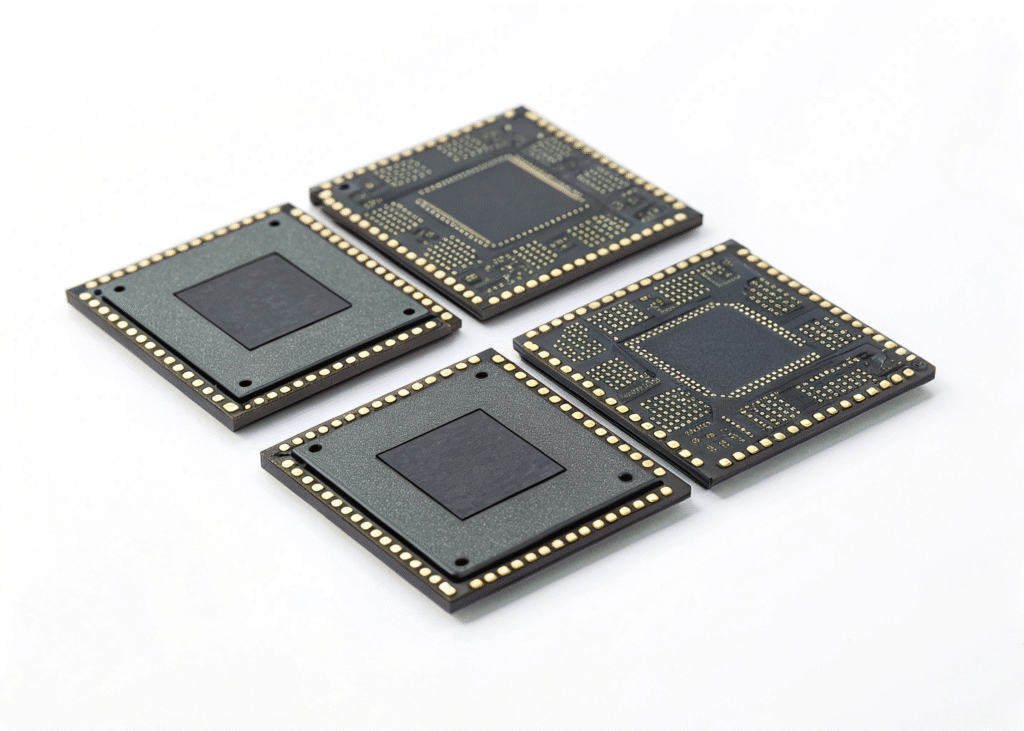
Why Vision Processing Demands Specialized AI Chips
AI vision cameras require immense computational power to interpret video streams, detect objects, and analyze scenes. Traditional CPUs and GPUs are not optimized for such continuous, low-latency inference at the edge.
Hailo’s processors are built specifically for AI workloads. They deliver hardware-level parallelism, dedicated neural cores, and low heat generation — making them ideal for compact devices like surveillance cameras, drones, and driver-assistance systems.
Unlike general-purpose chips, Hailo’s design supports modern model architectures, including convolutional and transformer-based networks, ensuring full-scale deep learning performance even in constrained environments.
Introducing the Hailo-15 AI Vision Processor
The Hailo-15 is a groundbreaking VPU (Vision Processing Unit) designed to bring AI intelligence directly into cameras. Offering up to 20 TOPS (Tera Operations Per Second), it combines Hailo’s field-proven inference technology with a complete vision subsystem for advanced image processing.
This processor enables simultaneous execution of multiple neural networks, handling detection, classification, and tracking in parallel — all within standard camera power and cost envelopes.
Its integrated image signal processor (ISP) ensures exceptional video quality, while built-in HDR, noise reduction, and stabilization deliver premium 4K60 imaging under any lighting condition.
Powering Real-Time Intelligence at the Edge
Modern applications like smart retail, transportation analytics, and perimeter security depend on immediate event detection. Hailo’s AI vision solutions empower these systems to process video locally, drastically cutting the need for external computation or cloud dependency.
By running neural networks directly on the camera SoC, Hailo devices deliver real-time insights — whether identifying traffic violations, monitoring factory production lines, or enabling advanced driver-assistance systems (ADAS).
This decentralization of compute not only accelerates response times but also strengthens data privacy, since raw footage no longer needs to leave the device.
The Architecture Behind Hailo’s AI Chip Technologies
At the heart of Hailo’s success is a neural network architecture that mimics the structure and efficiency of the human brain. Its design allows for distributed processing, where multiple data flows are handled concurrently without bottlenecks.
Each Hailo chip features a highly parallelized dataflow system that minimizes power consumption while maximizing throughput. This innovation allows devices to achieve desktop-level inference performance in a thermal and power profile suitable for embedded cameras.
Additionally, the chips are supported by Hailo’s software ecosystem — including the Hailo Dataflow Compiler and Model Zoo, which simplify AI model deployment across edge devices.
Bringing Generative AI to the Edge
With the release of the Hailo-10H AI Accelerator, Hailo is expanding beyond perception to generative AI capabilities. Running Large Language Models (LLMs) and Vision-Language Models (VLMs) directly on-device is now possible — opening the door to interactive, context-aware edge applications.
This new generation of AI chip technology merges creative intelligence with vision analytics, allowing cameras to interpret, describe, and even predict scenes dynamically. By combining generative capabilities with visual context, devices equipped with Hailo chips can understand environments more holistically than ever before.
AI Vision Cameras Across Key Industries
Hailo’s AI vision camera technologies are already shaping multiple markets:
- Automotive: Powering ADAS, autonomous driving, and in-vehicle monitoring with real-time visual perception.
- Security: Enabling smarter surveillance systems that detect anomalies, faces, and behaviors without offloading to the cloud.
- Industrial Automation: Supporting precision inspection, robotics, and smart manufacturing with embedded AI vision.
- Retail: Enhancing customer analytics and shelf monitoring with vision-based insights.
Each of these sectors benefits from lower latency, reduced cloud dependency, and energy-efficient inference — core strengths of Hailo’s processors.
The Advantage of On-Device AI for Privacy and Efficiency
As edge AI continues to evolve, privacy remains a defining factor. By processing data locally, Hailo chips eliminate the need to send sensitive visual information to remote servers. This not only minimizes risk but also complies with global data protection standards like GDPR.
Moreover, on-device intelligence drastically lowers operational costs, since less bandwidth and cloud storage are required. The result is an ecosystem of smarter, faster, and more sustainable connected devices.
Why Hailo Leads the AI Hardware Revolution
Hailo’s deep expertise in neural processing, combined with strategic partnerships across the automotive, industrial, and computing sectors, has positioned it as a pioneer in edge AI.
Its products — from the compact Hailo-8 and Hailo-10H accelerators to the powerful Hailo-15 VPUs — represent the industry’s most efficient bridge between high-performance computing and real-world deployment.
By focusing on scalability, flexibility, and developer accessibility, Hailo ensures that AI integration is seamless — from prototype to mass production.
FAQs
What makes Hailo’s AI chips unique?
Hailo’s processors deliver high TOPS performance with industry-leading power efficiency, purpose-built for edge AI workloads.
What is the difference between Hailo-8 and Hailo-15?
Hailo-8 is an accelerator module that enhances AI compute for edge devices, while Hailo-15 integrates full AI vision processing directly into cameras.
Can Hailo’s AI chips support generative AI models?
Yes. The Hailo-10H accelerator is optimized for running LLMs and generative AI workloads at the edge.
How does on-device AI improve data privacy?
By processing data locally, AI vision cameras avoid transmitting sensitive footage to external servers, reducing privacy risks.
What industries benefit most from Hailo’s vision solutions?
Automotive, security, retail, and industrial automation sectors leverage Hailo chips for real-time decision-making and analytics.
What is a VPU and how is it different from a CPU or GPU?
A Vision Processing Unit (VPU) is specialized hardware optimized for AI-based computer vision, delivering far greater efficiency than traditional processors.
Can developers integrate Hailo chips easily?
Yes. Hailo offers SDKs, compilers, and developer tools that simplify deployment across multiple embedded platforms.
How does Hailo support low-light and HDR imaging?
The Hailo-15 VPU includes an advanced ISP pipeline with HDR, noise reduction, and image stabilization for superior visual quality.
Is Hailo technology used in autonomous vehicles?
Yes. Hailo chips power ADAS and autonomous driving systems by enabling real-time perception and decision-making on the edge.
