
An edge gateway IoT is a vital component that sits between IoT devices (like sensors and actuators) and cloud platforms. It acts as a translator, filter, and traffic controller—collecting data from devices, converting various protocols into a common format, and forwarding only the necessary information to the cloud.
Choosing the right LoRaWAN providers ensures robust, secure, and scalable deployments—no matter your environment.
What Makes a Good LoRaWAN Provider?
The success of a LoRaWAN deployment hinges on the reliability of your provider. Network coverage is a primary concern—some providers operate public networks while others offer private or hybrid models depending on your geography and scale.
Top LoRaWAN providers should offer certified devices, compatibility with open standards, and easy onboarding processes. Look for platforms with user-friendly dashboards, APIs for integration, and robust analytics tools for data visualization and device management.
Support services also matter. Firmware updates, troubleshooting, and deployment support can make a big difference in your project’s long-term success. Pricing models should align with your usage patterns—whether you’re running a city-wide deployment or a targeted pilot project.
LoRaWAN stands out because of its low power consumption—devices can run for years on a single battery. This makes it perfect for large-scale sensor networks in agriculture, environmental monitoring, and utilities. It’s also capable of transmitting over several kilometers, even in dense urban environments.
The protocol’s star topology, where end-devices communicate directly with gateways, ensures simple and scalable architecture. Those gateways then forward the data to the cloud or to an edge gateway for further action.
How Edge Gateways and LoRaWAN Work Together
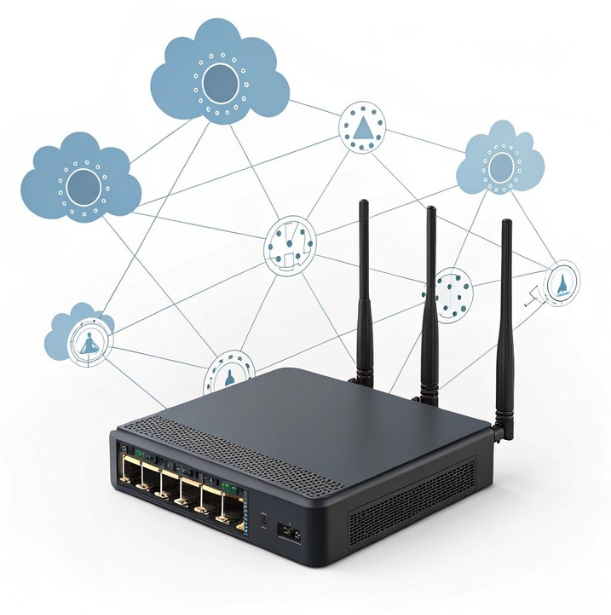
While LoRaWAN provides the long-range wireless transport, edge gateways add intelligence and control. In a typical setup, LoRaWAN sensors send their data to a gateway. That gateway is connected to an edge device, which processes the data locally—running analytics, detecting anomalies, or even triggering automated actions.
This architecture greatly reduces the amount of raw data that must be transmitted to the cloud. Instead of sending every temperature reading, the edge gateway might only transmit a notification if readings exceed a certain threshold. This approach saves bandwidth, enhances response time, and increases the resilience of the system.
Edge gateway IoT integration with LoRaWAN networks creates a hybrid model that blends central visibility with local autonomy. This is particularly useful in mission-critical applications like industrial automation, where milliseconds matter.
Key Features to Look for in Edge Gateway IoT Devices
When selecting an edge gateway for your IoT deployment, it’s important to look beyond basic connectivity. The ideal device should support a range of protocols—not just LoRaWAN, but also Modbus, MQTT, OPC-UA, BLE, and cellular options for backhaul.
Onboard storage and processing power allow for edge analytics, which can include everything from basic rule-based alerts to running AI inference models. Devices should also support over-the-air updates and remote management to ensure long-term flexibility.
Security features are non-negotiable. Gateways must support encryption, secure boot, firewall settings, and authentication mechanisms to prevent tampering or breaches.
Common Challenges in Edge and LoRaWAN Deployments
Despite their benefits, edge and LoRaWAN systems come with challenges. One major hurdle is interference, especially in urban or industrial environments where unlicensed frequencies can overlap with other signals. Careful frequency planning and adaptive data rate configurations can help mitigate this issue.
Another concern is power management, especially for battery-powered devices in remote areas. Developers must carefully balance sampling rates, transmission intervals, and data payload size to maximize battery life.
Integration can also be complex. Many legacy industrial systems don’t natively support LoRaWAN or edge architectures. In these cases, protocol bridges, converters, or edge logic may be needed to interface with older devices.
Lastly, the diversity of hardware and software platforms can complicate management. Using open standards and modular systems can make upgrades and scaling easier.
Security Considerations in LoRaWAN and Edge IoT
Security remains a top concern for any IoT deployment. LoRaWAN supports AES-128 encryption, but the implementation must be thorough. Devices need unique keys, and gateways should authenticate all traffic.
Edge gateways add a layer of protection by isolating device-level communication from the internet. By processing data locally and forwarding only selected packets, they reduce the exposure of your system to external attacks.
Secure boot, hardware-based encryption, intrusion detection, and signed firmware updates are all essential features for a secure edge gateway. Additionally, secure remote access for updates and configuration changes ensures that physical isolation doesn’t come at the cost of manageability.
The Future of Edge Gateway IoT and LoRaWAN
The evolution of IoT continues to favor decentralized, intelligent, and autonomous systems. Edge gateway IoT devices are expected to become more powerful—supporting AI and machine learning inference to detect patterns, forecast trends, and trigger automated actions without cloud involvement.
LoRaWAN, meanwhile, is expanding its role in private network deployments. From smart campuses to remote mining operations, organizations are deploying their own gateways and integrating them with edge logic to retain data sovereignty and improve performance.
Emerging features such as roaming between LoRaWAN networks, interoperability standards, and seamless device onboarding will drive broader adoption. We’ll also see tighter integration between LoRaWAN and other connectivity types, like 5G or satellite, with the edge gateway serving as the unified communication hub.
Edge gateway IoT integration with LoRaWAN networks isn’t just a technical option—it’s becoming the default architecture for scalable, secure, and intelligent IoT deployments. By combining localized processing with long-range, low-power connectivity, this duo enables faster responses, reduced cloud costs, and wider operational reach.
Combining secure edge gateway IoT devices with trusted LoRaWAN providers helps create a resilient and protected IoT architecture.
FAQs: Edge Gateways and LoRaWAN in IoT Deployments
1. What is an edge gateway in an IoT system?
An edge gateway is a device that connects IoT sensors to cloud platforms by collecting, processing, and transmitting data while supporting local decision-making.
2. How does LoRaWAN work in an IoT environment?
LoRaWAN is a low-power, wide-area network protocol that enables long-range wireless communication between IoT devices and gateways, ideal for remote or large-scale deployments.
3. Why integrate edge gateway IoT devices with LoRaWAN networks?
Integration enhances real-time processing, reduces cloud dependency, improves response times, and allows for low-power, long-range communication across various applications.
4. What are the advantages of using LoRaWAN providers?
Top LoRaWAN providers offer reliable network coverage, device compatibility, secure infrastructure, management platforms, and scalable pricing models for IoT projects.
5. What features should I look for in an edge gateway?
Key features include protocol flexibility, onboard processing, secure remote access, support for LoRaWAN and other networks, and the ability to update firmware over the air.
6. Can edge gateways improve IoT security?
Yes, edge gateways help by filtering traffic locally, reducing attack surfaces, supporting encryption, secure boot, and isolating device communication from the open internet.
7. What types of IoT applications use LoRaWAN?
LoRaWAN is widely used in smart agriculture, environmental monitoring, industrial automation, smart cities, and utility metering due to its long range and battery efficiency.
