
RF over Fiber (RFoF) converters are a critical technology for transporting high-frequency radio signals over optical cables, offering a solution that is more efficient and reliable than traditional copper or waveguide systems. For the most demanding applications pushing into the millimeter-wave spectrum, the ability to maintain signal purity is paramount. This is where high-performance RFoF converters, extending up to 67GHz, become essential, as their design directly impacts key performance metrics like the SFDR in RF (Spurious-Free Dynamic Range), which determines the system’s ability to distinguish a weak signal from background noise and distortion.
The Millimeter-Wave Challenge
Transporting signals in the extremely high-frequency (EHF) range, such as 67GHz, has traditionally been the domain of rigid, bulky, and expensive metallic waveguides. While effective over short distances, waveguides suffer from significant signal loss (attenuation) over longer runs, are inflexible, and are costly to install and maintain. As technologies like 5G/6G, advanced satellite communications, and next-generation radar systems utilize these higher frequencies, a more practical transport solution is necessary.
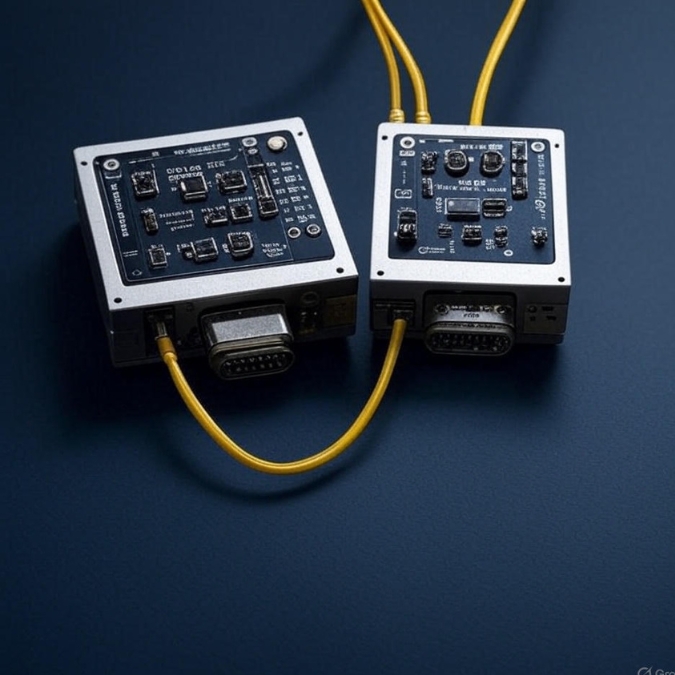
This is the problem that RF over Fiber converters solve. They provide a method to seamlessly convert these high-frequency electrical signals into light, send them over lightweight and flexible fiber optic cables with minimal loss, and then convert them back to their original electrical form at the destination.
Advantages of RF over Fiber at 67GHz
Using fiber optics for millimeter-wave transport offers a host of powerful advantages over traditional methods:
- Ultra-Low Signal Loss: A fiber optic cable exhibits incredibly low attenuation, regardless of the signal frequency it carries. A 67GHz signal can travel for many kilometers over fiber with negligible loss, a feat that is impossible with waveguides.
- Massive Bandwidth: Fiber optic cables offer enormous bandwidth potential, making them future-proof for even higher frequency applications.
- Complete EMI Immunity: Since the signal travels as light, it is completely immune to electromagnetic interference (EMI), radio frequency interference (RFI), and electrical noise. This ensures the signal remains pristine, even in electronically “noisy” environments.
- Flexibility and Reduced SWaP: Fiber optic cable is lightweight, flexible, and has a small diameter, making it easy to install in tight spaces within aircraft, ships, and communication towers. This results in a significant reduction in Size, Weight, and Power (SWaP) compared to waveguides.
- Enhanced Security: It is extremely difficult to “tap” a fiber optic cable without being detected, offering a higher level of security for sensitive data transmission.
Key Applications
The unique capabilities of 67GHz RF over Fiber converters make them essential for a range of cutting-edge applications:
- 5G/6G Networks: For connecting remote radio heads to central baseband units and for testing next-generation cellular communication systems.
- Satellite Communication Gateways: Ideal for linking large satellite dishes operating on Ka, U, and V-bands to indoor modem equipment located kilometers away.
- Aerospace and Defense: Used in radar test ranges, electronic warfare (EW) systems, and airborne communication platforms where low loss and high fidelity are critical.
- Radio Astronomy: Connecting sensitive antenna arrays in radio telescopes to central processing facilities without degrading faint cosmic signals.
